• Menu
  • Skip to right header navigation
  • Skip to main content
  • Skip to footer

Before Header

440.974.0808

  • Facebook
  • LinkedIn
  • Twitter
  • YouTube

Carver Financial Services

Helping you achieve your personal vision based upon your individual needs, goals and risk tolerance..

  • Our Approach
    • Personal Vision Planning®
    • Wealth Management Services
    • Team Advantage
  • About Us
    • Meet the Team
    • Our History
    • Awards & Recognition
    • Randy’s Story
    • Philanthropy
    • About Raymond James
  • Resources
    • Our Videos
    • Randy’s Blog
    • Raymond James Resources
    • Carver University
    • Resources for Business Owners
    • Client Access Videos
    • Client Communications
    • Seminar Material
    • Carver Financial ROKU® Channel
    • Carver Merch Store
    • Carver in the News
    • FAQs
  • Experiences
    • Our Events
    • Client Getaways
  • Contact Us
  • Client Login
  • Our Approach
    • Personal Vision Planning®
    • Wealth Management Services
    • Team Advantage
  • About Us
    • Meet the Team
    • Our History
    • Awards & Recognition
    • Randy’s Story
    • Philanthropy
    • About Raymond James
  • Resources
    • Our Videos
    • Randy’s Blog
    • Raymond James Resources
    • Carver University
    • Resources for Business Owners
    • Client Access Videos
    • Client Communications
    • Seminar Material
    • Carver Financial ROKU® Channel
    • Carver Merch Store
    • Carver in the News
    • FAQs
  • Experiences
    • Our Events
    • Client Getaways
  • Contact Us
  • Client Login

Paige Courtot

Three Best Practices to Handle Market Corrections

September 1, 2021 //  by Paige Courtot

“The stock market is the story of cycles and of the human behavior that is responsible for overreactions in both directions.” – Seth Klarman

One of the more unnerving parts of being an investor is experiencing the market pullback or market correction. Watching your investments fall by 10% (or more) is undeniably stressful, but the truth is: these events are as cyclical as the market itself, as long as there’s a stock market, there are going to be corrections. So, what can you do about it?

Humans hate losing more than they love winning, and for this reason, mistakes are often made when the market starts to dip. Just because market corrections are cyclical, doesn’t mean they’re predictable. Trying to time the market won’t work either, it’s impossible to know how long these things will last, how far the market will drop, or how quickly it will recover.

According to a table created by Merrill, timing the market could prove to be more damaging than holding, aka not touching your investments at all. Merrill evaluated the growth of $1,000 to see what happens when you leave an investment untouched over a 20-year period (Row 1); when you pull it out during the top 10 performing months (Row 2); and when you pull it out during the top 20 performing months (Row 3).

The Risk of Missing Out

  1990-2019 2000-2019 2010-2019
[1] Untouched $17,281 $3,242 $3,567
[2] Miss 10 top-performing months $7,000 $1,380 $1,723
[3] Miss 20 top-performing months $3,363 $722 $1,097

As you can see from the chart above the best overall strategy is leaving your $1,000 investment untouched for as many years as possible.

The fact of the matter is that the longer you’re investing in the market, the more likely you’ll experience a drop. The question is: how will the market correction affect you? Well, there are three different potential outcomes: 1.) You’re negatively impacted by it, 2.) There is no lasting impact on your portfolio, 3.) You actually benefit from the market correction. The outcome is largely up to you, but I’m guessing you’d like it to be outcome three and would at least accept outcome two.

Let’s go over the ways to prepare for, and take advantage of, a market correction so the next time one comes around you’ll be able to benefit from it.

Best Practice #1: Reduce Panic, Increase Planning

As with everything in life, making rash decisions while panicking leads to mistakes. Unfortunately, after decades of watching negative headlines create market volatility, combined with the increasingly hysteric nature of modern-day journalism, it can be tough not to live in a perpetual state of panic these days. You should not allow this panic to translate into how you do your financial planning. Do not make rash decisions in place of planned decisions.

To reduce panic, you must equip yourself with information. Luckily, there are plenty of cases analyzing years of data which can help investors gain perspective on market corrections. For example, when looking at post-World War II market declines, you can see that an overwhelming majority of dips occur in the 5-10% range and take about a month to recover from. This means that if you’re experiencing a dip in your portfolio, there is a non-negligible chance that you’ll recover your losses in a month or so.

Additionally, any decline between 5-20% also only takes a few months to recover from, while a decline between 20-40% takes a little over a year to recover from—this data demonstrates that patience is your friend when it comes to the market.

DECLINES

% # Avg % Avg Length (Mo.) Avg Recover Time (Mo.)
5-10 84 7 1 1
10-20 29 14 4 4
20-40 9 28 11 14
40+ 3 51 23 58

(source)

Obviously, all this data is gathered retrospectively after there’s been time to digest the decline but still, these figures provide a powerful perspective and encouragement. There’s no need to panic when you hear rumors of a market correction looming.

Best Practice #2: Diversify Your Portfolio

It’s not a question of if a market correction is coming, the question is when. Having cash in hand and a list of stocks you’ve been wanting to buy can turn a stressful time into an exciting one. A market correction is the perfect time to diversify your portfolio and an opportunity to buy in at lower rates. Think of it as a sale.

There are a few things to consider while you’re reevaluating your portfolio:

  • Consider your stock/bond mix. It’s always good to have a mix of cash, equity, and fixed income. The amount you have invested in each category largely depends on where you are in life, as well as your long-term/short-term financial goals. Market fluctuations shouldn’t cause you to move all your money into bonds just to avoid risk, but should instead be used as an opportunity to see if the reason you purchased certain stocks are valid in regards to your lifestyle.
  • Reevaluate your stock allocation. Using the cyclical nature of the stock market to your advantage can help you research which sectors you’d like to move into, and which ones are no longer useful to your financial goals. Overall, it’s best to broadly diversify your stocks, but with so many sectors to choose from, it can be hard to figure out where to invest. Using a market pullback to invest in some exciting sectors can help you take full advantage of the recovery.

Checking in with your portfolio during a market correction is the best way to prepare to make smart money moves when the market recovers.

Best Practice #3: Work with a trusted advisor

Having someone in your corner with an unbiased view will help immensely when it comes to harnessing market corrections to your advantage.  Our team has loads of experience with market corrections and is less likely to be emotionally triggered by the twists and turns of the market. Plus, with more than 250 years of combined experience, our team can help separate panic and emotion from financial decisions.

Your financial advisor will also be able to review both short-term and long-term goals, to give you options which complement your risk tolerance. They will provide you with a roadmap to help you from getting lost during turbulent times in the market.

Our firm has more than 30 years of experience in helping clients. I’ve seen every kind of market and every kind of reaction to it. There have been dozens of events in the past year that have been deemed “unprecedented” and scared people into thinking things were “different this time.” While I don’t want to downplay the tumultuousness of these times, I do want to reassure you that just because things feel unnaturally difficult, doesn’t mean that we can’t base our actions on what has worked in the past. The events may be different, but they always yield the same cause and effect.

I have experienced, first hand, almost 35 years of enormous societal changes, both amazing and horrendous. Even though the cyclical market is hard to pin down, and impossible to time, the fundamental financial decisions that add up to sound investments are not. Our team is here for you, along with our decades of experience, to help make sense of what’s the best financial plan for your personal vision.

Randy Carver, CRPC®, CDFA®, is the president and founder of Carver Financial Services, Inc., and is also a registered principal with Raymond James Financial Services, Inc. Randy has more than 32 years of experience in the financial services business. Carver Financial Services, Inc. was established in 1990 and is one of the largest independent financial services offices in the country, managing $2.2 billion in assets for clients globally, as of August 2021. Randy and his team, work with individuals who are in financial transition as a result of divorce, retirement, or the sale of a business. You may reach Randy at randy.carver@raymondjames.com.

Links are being provided for information purposes only. Raymond James is not affiliated with and does not endorse, authorize or sponsor any of the listed websites or their respective sponsors. Raymond James is not responsible for the content of any website or the collection or use of information regarding any website’s users and/or members.

Category: Blog

Carver Financial ROKU® Channel

August 30, 2021 //  by Paige Courtot

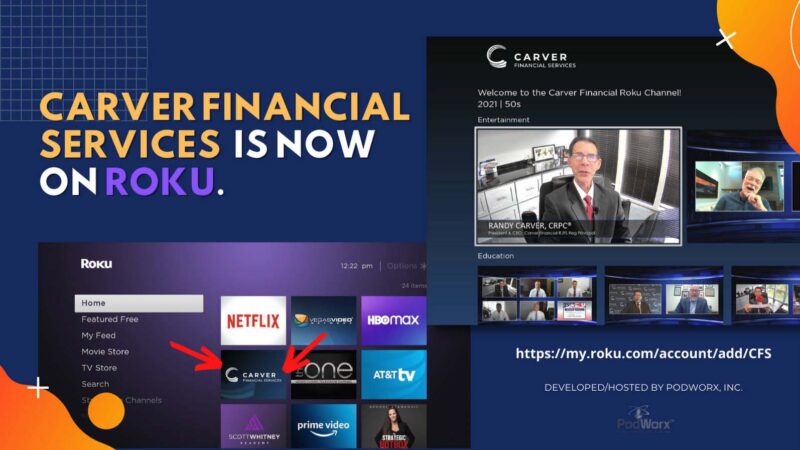
How do I add the Carver Financial channel to my Roku® streaming device?

Just like your smartphone accesses an “app store” to add new applications, your Roku streaming player or Roku TV™ accesses the Roku Channel Store to add new channels. Browse the Roku Channel Store directly from your Roku device, or by visiting channelstore.roku.com to find the “Carver Financial Services” channel. The channel can also be added when using the Roku mobile app on a compatible mobile device.

  • Note: When you add a channel to your Roku device, you are actually adding it to your Roku account. As a result, the channel will automatically be added to all Roku devices linked to your Roku account. When you remove a channel, the same is true. It will be removed from all Roku devices linked to your Roku account.

Adding channels from your Roku device

  1. Press the Home button on your Roku remote.
  2. Scroll up or down and select Streaming Channels to open the Channel Store.
  3. Select Search Channels and enter the keywords, “Carver Financial”.
  4. Navigate to the right and highlight “Carver Financial Services – Wealth Management”
  5. Press the OK button  on your remote to open the details. In addition to a synopsis and rating, you can preview screenshots of the channel.


  6. Select Add Channel to install the channel on your Roku device.

Questions or need assistance? Please call our office at 440-974-0808.

Category: Roku

32nd Annual Client Appreciation Event

August 27, 2021 //  by Paige Courtot


Carver Financial held its 32nd Annual Client Appreciation Event Captain’s game at Classic Park on Friday, August 13th. Nearly 1,800 attended and had a great time despite the rain.

Category: Video

Randy Carver Named to Forbes’ 2021 List of Top 250 Wealth Advisors in the U.S.

August 27, 2021 //  by Paige Courtot

August 25, 2021 – FORBES published its 2021 list of Top 250 Wealth Advisors in the United States. This is the sixth year in a row that Randy Carver, President of Carver Financial Services Inc. and registered Principal with Raymond James Financial Services Inc., was included in this prestigious list. There were more than 33,567 nominations received from across the country, seven were recognized in Ohio, with Randy Carver being ranked #111.

Randy’s profile – https://www.forbes.com/profile/randy-carver/#13c1301c739a

Full story – https://www.forbes.com/top-wealth-advisors/#7528c2cf1a14

The Forbes ranking of the Top 250 Wealth Advisors, developed by SHOOK Research, is based on an algorithm of qualitative criteria, mostly gained through telephone and in-person due diligence interviews, and quantitative data. Those advisors that are considered have a minimum of seven years of experience, and the algorithm weights factors like revenue trends, assets under management, compliance records, industry experience and those that encompass best practices in their practices and approach to working with clients. Portfolio performance is not a criteria due to varying client objectives and lack of audited data. Out of approximately 33,567 nominations, 250 advisors received the award. This ranking is not indicative of an advisor’s future performance, is not an endorsement, and may not be representative of individual clients’ experience. Neither Raymond James nor any of its Financial Advisors or RIA firms pay a fee in exchange for this award/rating. Raymond James is not affiliated with Forbes or Shook Research, LLC. Please see https://www.forbes.com/sites/rjshook/2021/08/24/methodology-americas-top-wealth-advisors-2021/ for more info.

Category: Awards

Carver Financial Services recognized as a 2021 ThinkAdvisor LUMINARY

August 24, 2021 //  by Paige Courtot

August 17, 2021, Carver Financial Services, Inc., was named to the inaugural class of 2021 ThinkAdvisor LUMINARIES in the key area of Thought Leadership & Education. This new and pioneering financial industry recognition program — ThinkAdvisor LUMINARIES — celebrates top advisors, industry executives, teams, RIAs, broker-dealers, asset/investment/portfolio managers, and other firms by showcasing their achievements. The award highlights how top-performing industry participants are producing meaningful results in the areas that matter most to advisors and their clients. The winners were selected by a distinguished and diverse panel of judges from across the advice industry, as well by the ThinkAdvisor editorial team. Carver Financial will be honored at the inaugural ThinkAdvisor LUMINARIES Awards Dinner, which will take place on November 9, at the Mandarin Oriental in New York.


“It is a tremendous honor for our team to be recognized as one of the top independent financial advisory firms in the United States, as part of ThinkAdvisor’s inaugural awards program.” Randy Carver, President & CEO, Carver Financial Services, Inc. RJFS Registered Principal said. “This achievement is a direct reflection on the commitment and dedication to excellence of every member at Carver Financial, as we strive to be one of the most highly-educated teams at Raymond James.”

Visit https://www.thinkadvisor.com/2021/08/16/meet-the-luminaries-class-of-2021/ for a list of award winners.

Carver Financial Services Inc. offers securities through Raymond James Financial Services, Inc. Member FINRA/SIPC. Investment Advisory Services offered through Raymond James Financial Services Advisors, Inc. Carver Financial Services Inc. is not a registered broker/dealer and is independent of Raymond James Financial Services.

ThinkAdvisor’s LUMINARIES awards aim to celebrate the achievements of advisors, industry executives, teams, RIAs, broker-dealers, asset managers and other firms by showcasing their achievements in four key areas, including Diversity & Inclusion, Thought Leadership, Executive Leadership and Dealmaking/Growth. Members of the Class of 2021 LUMINARIES were selected by a diverse panel of judges from across the advice industry, and the ThinkAdvisor editorial team. Out of several hundred participants and nominations, the winners represent individuals, companies and executives from 150 firms. For the Thought Leadership & Education award, the judges looked for a clear demonstration of leadership and innovation in how the industry is approaching a key area, such as advisor training/consulting, retirement, financial planning, practice management, client education, behavioral finance, human resources and compliance. The individuals and/or firms needed to have launched a program or project that has not been done before for clients or other industry participants. Such efforts must be improving or aiming to improve current industry thinking and approaches to key issues. The ranking may not be representative of any one client’s experience, is not an endorsement, and is not indicative of advisor’s future performance. Neither Raymond James nor any of its Financial Advisors pay a fee in exchange for this award/rating. ThinkAdvisor and ALM Media Properties, LLC are not affiliated with Raymond James.


Category: Awards

The News-Herald

August 16, 2021 //  by Paige Courtot

Wings & Wheels 2021 event
Click to read full article


Category: Media

Don’t Fall for These Common Cyber Scams and Frauds

August 2, 2021 //  by Paige Courtot

It’s happened to all of us one way or another: You suddenly receive an email saying that your credit card information has been compromised. You need to contact the bank to verify your information due to suspicious activity.

Or you get a call that your grandkid is in jail and they need bail money as soon as possible.

Maybe it’s good news – you just “won” the Publisher’s Clearing House Sweepstakes and they just need your account number to wire you the money.

These are all examples of real-life scams. As technology becomes more sophisticated, so do scammers. It’s getting more difficult to discern between legitimate communication and nefarious hackers trying to rob you of your money.

There are many companies dedicated to stopping these types of scams; however, fraud can be hard to combat. One reason for this is because the victims are too embarrassed to report the crime.

Let’s first walk through important information you should know about cyber scams and frauds. Then, we’ll take a look at how you can avoid them. Finally, we’ll go over a few simple tactics to use if you’re the victim of fraud.

Fraud is Common

Before evaluating ways to protect yourself and your money against digital robbery, it’s important to note that this is a common, widespread problem faced by people all over the world.

According to a study conducted by the Centre for Counter Fraud Studies at the University of Portsmouth, 65- to 74-year-olds are 54 times more likely to be victims of fraud or computer scams than they are to be physically robbed.

Newly released data shows that the Federal Trade Commission received more than 2.1 million fraud reports in 2020 alone. The same data found that imposter scams — when a fraudster pretends to be someone in need to trick you into sending them money — were the most common types of fraud reported to the agency. 1 in 5 individuals reportedly falling victim to this particular scam.

Here are some other statistics to be aware of:

2020 Top 3 Scam Categories

  • Identity Theft
  • Imposter Scams
  • Online Shopping and Negative Reviews

2020 Reported Fraud Metrics

  • Reports of Fraud: 2.2 Million
  • Reported Losses: $3.4 Billion total
  • Median Losses: $308 per reported incident

Fraud is a prevalent problem in today’s digital age. You can protect yourself and your savings by surrounding yourself with trusted professionals.

Now, we’ll cover different types of scams and how to identify them.

Cyber Scams and Red Flags

In order to protect yourself, it’s good to learn about the different types of scams out there. Here are some of the most common schemes:

Investment Fraud

Ponzi schemes, advance fee fraud, pyramid schemes, and market manipulation fraud are all examples of Investment Fraud. There’s probably a catch if someone you don’t know very well offers you an opportunity like:

  • Low-or-no-risk investments with guaranteed returns
  • Complex business strategies
  • Unregistered securities

Elder Fraud

Elder Fraud criminals go after millions of elderly Americans each year. Con artists gain a victim’s trust, then when their victim’s guard is low, these criminals strike.

Some of the most common schemes include:

  • Romance scams
  • Sweepstakes/charity/lottery scams
  • Tech support scams
  • Grandparent scams — bad actors pose as a relative claiming to be in immediate financial need

Charity and Disaster Fraud

These scams take advantage of individuals’ benevolence and are especially rampant after high-profile disasters. Charity and Disaster Fraud is when a fake organization asks for donations to help combat a national emergency. It can also be as insidious as false contractors offering aid with the intent to run off with the insurance money.

COVID Scams

While COVID Scams live under the umbrella of “Charity and Disaster Fraud,” I want to highlight this particular scam. Scammers live off of vulnerability and fear – both of which are running high due to the pandemic.

Scammers try to obtain personal information like your social security number. If you receive an unsolicited phone call or message asking for sensitive information under the guise of COVID Aid, make sure to think critically. Always ask to know who is calling and which organization they’re representing.

Phishing/Ransomware Attacks

You may hear a lot about big companies experiencing “ransomware attacks” lately. Did you know that these attacks usually occur through an individual employee’s unprotected computer?

Phishing schemes and Ransomware attacks usually happen to individuals who are not vigilant with their software updates and internet use. Hackers access your data through corrupt files and links sent to your email inbox.

They’ve become so savvy that they can create email accounts and messages that impersonate brands and people you trust. This is why it’s very important to double and triple-check the spelling of email names, links, and websites before you click on them.

A good rule of thumb is that if an email, link, or file seems “off,” it probably is.

There are endless opportunities for those with bad intentions to take advantage of good people. The shame and silence surrounding being scammed just adds more fuel to the fire.

Ways to Avoid Being Scammed

Because so much scam and fraud now occur on the internet, it’s important to learn good “cyber-hygiene.” Be sure to keep your passwords protected and avoid clicking on compromised links.

Here are a few other things you can do to protect yourself from being scammed:

  • Avoid opening email attachments (or hyperlinks) from people or brands you don’t know.
  • Double-check to make sure links don’t have odd spelling. For example, you may get an email notification claiming someone you know tagged you in a “Facebook Photo” only to see later “Facebook” was spelled with three ‘o’s and you got phished.
  • Never provide personal information in response to an unsolicited email, robocall, or robotext. In fact, it’s a good practice not to provide any personal information digitally. A trusted company will give you safe options for providing personal information including an in-person visit or calling them instead of them randomly calling you.
  • Resist the pressure to act quickly. Scammers create a sense of urgency to produce fear and lure victims into immediate action. If you feel there is immediate danger to you or a loved one, it’s better to call the police.
  • Be cautious of unsolicited phone calls, mailings, and door-to-door services offers.
  • Never give or send any personally identifiable information, money, gift cards, checks, or wire information to unverified people or businesses.
  • Trust your gut: If something seems a little off then it probably is.
  • Anyone can make a sleek website these days. Before sending money to a company, charity, or person, double-check that there are legitimate reviews of their services.

Even with the best “cyber-hygiene,” you may still find yourself as the victim of a scam or fraud. Here are some steps to take if this happens.

Steps to Take if You’ve Been a Victim of Identity Fraud

Many cybercriminals are trying to get your identity. If they are able to get your social security information and your bank account numbers, there are endless opportunities for them to cause headaches and hassles.

Here are a few activities they can pursue with personal information:

  • Filing state and federal tax returns in your name
  • Getting unemployment
  • Signing up for medical care and prescription drugs
  • Taking on the identity of a deceased person

If you or a loved one are in this unfortunate position, here are steps to take back control:

  1. Go to IdentityTheft.gov Here, you can report that your identity was stolen and also start to recover from this crime. This website will make sure you cover all your bases and are fully equipped with the information needed to move forward.
  2. Check your credit reports to confirm you’ve had a fraudulent account opened in your name. If this is the case, immediately notify all four credit report organizations (Equifax, TransUnion, Experian, Innovis) of fraud. After these four organizations have been notified, freeze your reports. You can do this by phone, mail, or online.
  3. File a report with your local police.
  4. Notify the Office of the Inspector General (the Social Security Administration) via their fraud hotline at 1-800-269-0271 or submit a report online at oig.ssa.gov. You should also alert the Internal Revenue services at 1-800-829-0433.
  5. Contact your state taxing agency. All agencies can provide instructions on how to address the situation.
  6. Alert any organizations that have access to your finances, including financial advisors.
  7. Finally, be sure to notify your medical insurance providers.

*Source: “Simple Safeguards: How to Stay Safe from Identity Theft and Cybercrime” by Jeff Lanza

It’s important to remember that there is no shame in being scammed. Sophisticated criminals have fooled even the most vigilant individuals.

Key Takeaways

It may seem like there’s a lot to learn when it comes to fraud and scams. Once you understand a few key pieces of information, you’ll feel empowered to protect yourself.

Here are the most important things to remember:

  • Being a victim of fraud or a scam is never your fault and isn’t something to be ashamed of
  • If you become a victim, report the incident immediately
  • Fraud and scams can happen via email, telephone, or in-person
  • Avoid disclosing personal information with anyone you don’t trust
  • If something seems “off” or suspicious, it probably is

Are you interested in learning more about how to protect yourself from fraud? Read on.

Learn How to Protect Yourself at our 26th Annual Resource Breakfast

For more helpful tips on how to protect yourself against cybercrime, we would like to invite you and your guests to join us at our 26th Annual Resource Breakfast on January 22, 2022. We will feature former FBI special agent Jeff Lanza as our keynote speaker.

Jeff is one of the leading experts on how to protect yourself from cybercrime. He has provided over one thousand presentations on the topics like:

  • Cybercrime
  • Leadership
  • Crisis communication
  • Ethics
  • Identity theft
  • Body language

His clients include 20th Century Fox Entertainment, Citigroup, The Young Presidents Organization, American Century, Hallmark, and others.

Jeff will present a program on identity theft prevention that will inform and educate you on what to look out for when protecting yourself against cybercrime.

Save the date for our 26th Annual Resource Breakfast on January 22, 2022. Registration will open shortly. More details to follow.

Carver Financial Services Has Your Back

From technological safeguards to employee policies and operating procedures, we maintain constant vigilance when your privacy is concerned.

Carver Financial Services recognizes the trust you place in us when you disclose personal information. One of our core tenants is maintaining that trust by ensuring your information is secure.

We proudly work with Raymond James who has a dedicated Privacy Office committed to the privacy and protection of the personal information you have entrusted to us.

Both Carver Financial and Raymond James take very proactive measures to protect you. From technological system monitoring 24 hours a day, 365 days a year to utilizing only the best protection technology, including:

  • Encryption
  • Virtual private networks
  • Penetration/vulnerability testing
  • Top-of-the-line firewall and antivirus technology

Cybersecurity is crucial to the framework of Carver Financial Services. You can rest assured that your information is safe with our team of talented individuals. Ultimately, though, you must also be vigilant about protecting yourself against the social engineering prevalent in the digital age.

Randy Carver, CRPC®, CDFA®, is the president and founder of Carver Financial Services, Inc., and is also a registered principal with Raymond James Financial Services, Inc. Randy has more than 32 years of experience in the financial services business. Carver Financial Services, Inc. was established in 1990 and is one of the largest independent financial services offices in the country, managing $2.1 billion in assets for clients globally, as of July 2021. Randy and his team, work with individuals who are in financial transition as a result of divorce, retirement, or the sale of a business. You may reach Randy at randy.carver@raymondjames.com.

The information contained in this report does not purport to be a complete description of the securities, markets or developments referred to in this material. The information has been obtained from sources considered to be reliable, but we do not guarantee that the foregoing material is accurate or complete. Any information is not a complete summary or statement of all available data necessary for making an investment decision and does not constitute a recommendation. Any opinions are those of Randy Carver and not necessarily those of RJFS or Raymond James. Expressions of opinion are as of this date and are subject to change without notice. Links are being provided for informational purposes only. Raymond James is not affiliated with and does not endorse, authorize or sponsor any of the listed websites or their respective sponsors.

Category: Blog

The ABCs of ESGs

July 1, 2021 //  by Paige Courtot

Environmental and social issues are dominating headlines. Increasingly we are hearing about environmental, social governance (ESG) investing. Is this just a marketing ploy or is there validity to ESG-focused brands? In order to answer those questions, let’s first break down what “ESG investing” actually means.

ESG in A Nutshell

ESG stands for environmental, social, and governance—these are a grouping of non-financial factors that evaluate the sustainability of a company or fund. The goal of ESG investments is to utilize capital assets to find ways that positively impact society at large, whether it be through social means or environmental ones. ESG investing gives individuals the opportunity to conscientiously grow their portfolios in ways that might better align with their social values.

While “socially responsible investing” may seem like a trendy concept plucked from the Twitter feeds of today, the idea to allocate money for ESG-like securities dates back to the 1950s. During this post-World War II boom, trade unions began investing their considerably large pension funds in altruistic areas like affordable housing projects and health facilities.

In fact, so many individuals and institutions are shifting focus to ESG-considerations that global sustainable fund flows hit a record high of $45.6 billion in Q1 of 2020. The United States was responsible for contributing a whopping $10.4 billion to that total.

Is ESG Investing Right For You?

Okay, so sustainable investing is popular, but does it work? Various studies have shown that ESG investments are becoming more competitive both in price and performance. An article released by The Forum for Sustainable and Responsible Investing curated studies from many reputable sources, stating that, “investors do not have to pay more to align their investments with their values, or to avoid companies with poor environmental, social or governance practices.”

Another recent report published by Money Management Institute and The Investment Integration Project summarizes why investors are beginning to consider ESG-inclusive portfolios:

  • Companies with sustainability in mind are better at managing risk and have “less systemic volatility than their conventional peers.”
  • Capital costs are lower at companies that participate in sustainability practices, which encourages growth, shareholder returns, and often positively impacts the value of the company.
  • Private equity and debt-focused sustainable investments are shown to achieve market-rate returns.

With sustainable investing growing in popularity, it’s important to work with a knowledgeable advisor who has experience and knowledge in the area of ESG investing to see if it is right for you. Unfortunately, there are a lot of companies that may falsely use the ESG label to attract more investors, when in reality they are not sustainable brands. This misleading behavior is called “Greenwashing.”

Don’t Get Fooled by Greenwashing

It can be hard to spot which companies are actually invested in making sustainable change and which companies are taking advantage of a trend. Without concrete regulations and/or definitions of sustainable criteria, it’s up to the company to decide whether or not they fall under the ESG classification—which means there’s lots of room for interpretation. As the popularity of ESG investing grows there is a growing movement to standardize metrics for ESG and put in place requirements to use this term.

Given the ambiguity of the term ESG, here are a few things to help you do your due diligence and look out for and avoid Greenwashing in your funds. Of course, working with a trusted advisor is the best way to make sure the funds truly meet your personal goals.

  1. Do your research. If a company or fund makes a claim about their ESG-practices, check their website and certifications to make sure this claim is backed up. Vague or inconsistent claims are a red flag. Actual ESG companies should be completely transparent and proud to share their data.
  1. Watch what they do, not how they market. A popular greenwashing practice is using buzzwords on product packaging, such as “all-natural,” “earth-friendly,” “non-toxic,” “100% organic”, etc. These words are useless without actions to back up their existence. Just because a house cleaning brand has a product with the word “green” on the label, doesn’t mean the company falls into the ESG category.
  1. Be familiar with the rules. For example, many products are quick to point out that they are CFC-free. CFCs are gaseous compounds that can be found in refrigerants, cleaning solvents, and aerosol propellants. While getting rid of toxic gas is certainly an environmental win, CFCs are now banned. So, the claim “CFC-free” may look good on paper, but in reality, it’s required by law and therefore not a good indicator of sustainability.

Morningstar offers a Sustainability Rating tool to help you figure out if a company you’re interested in investing in has a strong background in sustainability. Using an objective facts-based tool such as Morningstar may help you avoid falling victim to false marketing.

Overall, the growing interest in ESG investing marks an opportunity for those who are interested in taking on a more socially and environmentally, conscientious investing strategy. However, data is key when parsing through all the investments claiming to be socially responsible. While there aren’t universal metrics to measure sustainability, regulators are looking at creating standards for labeling investments as such.

Whether you work with a trusted advisor or on your own, ESG investing is yet another option to grow your wealth. Many investors may not be concerned about environmental or social compliance and simply want to grow their portfolios; ultimately, ESG may still make sense as part of a well-diversified plan offering potentially more stability than non-ESG offerings.

With the current push for the use of electric vehicles, alternative energy, and reductions in carbon emissions, ESG investing will continue to receive more attention.

Since 1990 the mission of Carver Financial Services has been to Make People Lives’ Better. As part of this mission, we offer ESG compliant strategies. ESG is certainly not for everyone and continues to evolve. We can discuss what is important to you and figure out how to invest your overall portfolio in a way that meets both your needs and personal values whether that includes ESG or not.

Randy Carver, CRPC®, CDFA®, is the president and founder of Carver Financial Services, Inc., and is also a registered principal with Raymond James Financial Services, Inc. Randy has more than 32 years of experience in the financial services business. Carver Financial Services, Inc. was established in 1990 and is one of the largest independent financial services offices in the country, managing $2.1 billion in assets for clients globally, as of July 2021. Randy and his team, work with individuals who are in financial transition as a result of divorce, retirement, or the sale of a business. You may reach Randy at randy.carver@raymondjames.com.

The information contained in this report does not purport to be a complete description of the securities, markets or developments referred to in this material. The information has been obtained from sources considered to be reliable, but we do not guarantee that the foregoing material is accurate or complete. Any information is not a complete summary or statement of all available data necessary for making an investment decision and does not constitute a recommendation. Any opinions are those of Randy Carver and not necessarily those of RJFS or Raymond James. Expressions of opinion are as of this date and are subject to change without notice. Links are being provided for informational purposes only. Raymond James is not affiliated with and does not endorse, authorize or sponsor any of the listed websites or their respective sponsors.

Incorporating sustainable investing criteria into the investment selection process may result in investment performance deviating from other investment strategies or broad market benchmarks. 

Category: Blog

Chris Warner

June 20, 2021 //  by Paige Courtot

Chris Warner shares stories from K2, arguably the most dangerous mountain in the world.

Watch Chris Warner, one of America’s most accomplished mountaineers, share stories and footage from when he reached the summit (on his third attempt) and became just the ninth American to summit K2 and Everest. By comparison, only 12 people have walked on the moon!


Raymond James and Carver Financial Services are not affiliated with Chris Warner.

Category: Video

Looking in the Rearview Mirror Works…Until the Road Curves

June 2, 2021 //  by Paige Courtot

Looking in the rearview mirror while driving works…until the road curves. This is a good principle to keep in mind when investing; the past performance of your investments does not guarantee future growth.

When it comes to market performance, we believe the road is heading for a curve.

In the past year, the United States has seen unprecedented fiscal stimulus, with the money supply increasing by 30-percent. The Fed has taken a laissez-faire approach to these developments, keeping interest rates at virtually zero while the economy reopens after pandemic closures. These factors combined will likely result in high inflation over the next few years—something we have not seen in recent decades.

It’s important, as investors, to ask ourselves, “How will I be affected by what is going to happen?” Ultimately, there’s no foolproof way of predicting the future. That is why our Personal Vision Planning® process takes into account periods of uncertainty and market volatility. We believe that with proper planning, you’ll be able to handle any shifts in the economy no matter what transpires.

Having a strong grasp of the macroeconomic outlook and conditions can provide context for planning. There is broad consensus that we can expect higher inflation and higher taxes in the future. The question is, how can we not only protect ourselves but also take advantage of these tax-hikes to build wealth?

Economists Warn of a Sharp Rise in Inflation

Larry Summers is a center-left economist who was formerly the Treasury Secretary under President Clinton and head of the National Economic Council under President Obama. Summers has called Biden’s economic efforts the “least responsible” macroeconomic policy in 40 years.” He believes the amount of extra spending is far in excess of what’s needed to get the economy back to where it would have been in the absence of COVID-19. “If your bathtub isn’t full, you should turn the faucet on, but that doesn’t mean you should turn it on as hard as you can and as long as you can,” Summers told National Public Radio on February 2, 2021.

Jeremy Siegel, Professor of Finance at Wharton, is also forecasting a sharp rise in inflation over the next few years. During an interview on CNBC’s Halftime Report, “Prices are going to be 20% higher three years from now, four years from now than they are today.”

The current chair of the Federal Reserve, Jerome Powell, has the Federal Reserve setting short-term interest rates at essentially zero and buying $120 billion per month in Treasury and mortgage-related securities. Moreover, the Fed is committed to keeping these policies in place for the foreseeable future.

William Dudley, the chief economist for Goldman Sachs and the president of the New York Federal Reserve Bank from 2009 to 2018, has also issued warnings, saying that he thinks the Fed is putting itself in a position where it’s going to have to eventually raise rates aggressively. If the Fed is too slow to tighten “monetary policy” says Dudley, it will have to eventually “catch up.” That caching up, according to Dudley, will not be “pleasant.”

A Market Correction Might Be Looming

Whatever is going on in the world at any given moment affects the stock market—we can all agree that there is a lot going on.

Almost daily, we see a new story featuring economists predicting a market crash due to the current bullishness of the market. That’s to be expected, market corrections are pretty common. In fact, a double-digit decline has occurred in the S&P 500, on average, every 1.87 years since 1950. While it’s important to factor these warnings into your due diligence, it’s even more pressing to note that these peaks and valleys are cyclical.

Fixed-Income Investments

As more investors grow concerned about a significant correction, they begin to consider moving non-negligible portions of their portfolios to fixed income (aka bonds) investments. We believe this is one of the worst things you can do in this environment.

In the past, people have viewed fixed income as safe and stable, so they shift assets to these types of investments when equity markets become more volatile. This worked when interest rates were decreasing, but because we are reaching a bend in the road shifting a large percentage of capital to fixed income might be a mistake due to the predicted increased inflation and interest rates on the horizon.

Consider Equity Assets Instead

The only investment that could provide real returns (returns net of inflation and tax) are equity assets. At this time some equity investments have yields that are higher than those for fixed income, while also offering growth potential

As always, we recommend a diversified asset allocation based on your needs and risk tolerance. We believe it’s important to have enough cash to cover any expenses anticipated in the next 12 months, once you have this under your belt, you can consider what to do for your other investments. For the portion of the portfolio in fixed income, look at very short-duration holdings and tax-exempt bonds if you are in a higher tax bracket.

Chart Your Own Path

Another example of driving down the road, looking in the rearview mirror when you should be watching for curves is planning based on the recent past or on your parents’ financial experiences. The average lifespan is increasing which means people will need more income later in life, that’s why it is important to stay invested for growth. When someone used to retire at 65 and die before 75, growth was not as much of an issue. Now, many people retire before 60 and live well into their 90s—which is an amazing thing, but isn’t so amazing for modest retirement plans. This is yet another reason maintaining a significant allocation in your equity assets vs. fixed income investments is important.

The key to avoiding financial hardships later in life is to actively monitor and rebalance your portfolio with a long-term view in mind. Having equities will help preserve value over time, even if there is volatility in the short run. Trying to time the market does not make sense; rebalancing a portfolio to a predetermined allocation does. This is where a trusted advisor can add significant value.

Our Recommendations

Given all of these confusing, fast-moving shifts and events, here is what we recommend for you:

  • Have enough cash that you are never forced to sell in the short run.
  • Actively monitor and rebalance your portfolios—do not try to time the market, try to maintain your agreed-upon allocation instead.
  • Understand that we might see a rising interest rate and an inflationary environment. Fixed income will be impacted when this happens.
  • Think about why you are investing. If your portfolio is generating the income you need to maintain your lifestyle, the value of your portfolio is not important. This is similar to having a rental home—the rent will be paid to you, regardless of the value of the property.

Be Prepared for Rising Tax Rates

We also expect that capital gains, estate, and income tax rates will rise in the next few years—regardless of the party in power. The challenge facing politicians is how to pass increases that will not upset voters. As such, elevated rates are likely to be seen in more arcane categories like the step-up in basis on estates or corporate taxes. Working with your advisor and CPA to manage your portfolio in the most tax-efficient manner is critical to stay ahead of these increases.

At the end of the day, the most important thing is not how much your portfolio earns, but how much you net in your pocket after fees, expenses and taxes. Having tax-exempt growth is a “free lunch” and who doesn’t love a free meal? As taxes go up, it becomes important to be as tax-efficient as possible. We take a very proactive approach to this and work with your CPA to develop a strategy that is best for your situation.

We do not believe major changes to your financial management strategies should be made in anticipation of tax-law changes. We recommend waiting to see what actually passes. The reality is that the actual rules are often less draconian than how they’re presented. That’s why we recommend you:

  1. See if tax-exempt investments make sense, given your tax rate.
  2. Consider converting tax-deferred retirement accounts to tax-exempt ROTH IRAs.
  3. Consider tax swaps and tax-efficient investments.

Look Ahead with Your Professional Team

In summary, we believe we will see higher income tax rates, higher inflation, and more volatility in both the equity and fixed-income markets. Volatility could actually provide an opportunity for people who prepare by taking an active approach to monitoring their portfolios.

As tax laws become more complex, people live longer, and need more income, it’s important to allow your portfolio to grow and evolve with the times. However, the information on the internet can be confusing, misleading, or outright inaccurate, that’s why it’s more critical than ever to work with a trusted advisor.

Having worked in the financial services industry for more than 30 years, I see that individuals who are unprepared or tend to react to short-term events, generally losing wealth over time. These knee-jerk tendencies create a lot of emotional and financial strain. That’s why I always advise a proactive—not reactive—approach to investing.

Our Personal Vision Planning Process® is not dependent on predictions or forecasts. We expect the unexpected and plan accordingly. It is clear that inflation will continue to increase, we believe this is one of the biggest risks that investors face today. And, even though we also expect increased volatility in the stock market, this may be one of the best places to invest.

Those who work with a trusted advisor, stick with their plan, and take a long-term view may actually benefit from periods of volatility while not only maintaining but enhancing their lifestyles. We are being met with economic, political, and market changes we have not seen in decades. The road is curving, those who look ahead—and work with a professional team—can benefit. Those who look in the rearview mirror may ultimately drive off the road.


Randy Carver, CRPC®, CDFA®, is the president and founder of Carver Financial Services, Inc., and is also a registered principal with Raymond James Financial Services, Inc. Randy has more than 32 years of experience in the financial services business. Carver Financial Services, Inc. was established in 1990 and is one of the largest independent financial services offices in the country, managing $2.1 billion in assets for clients globally, as of June 2021. Randy and his team, work with individuals who are in financial transition as a result of divorce, retirement, or the sale of a business. You may reach Randy at randy.carver@raymondjames.com.

The information contained in this report does not purport to be a complete description of the securities, markets or developments referred to in this material. The information has been obtained from sources considered to be reliable, but we do not guarantee that the foregoing material is accurate or complete. Any information is not a complete summary or statement of all available data necessary for making an investment decision and does not constitute a recommendation. Any opinions are those of Randy Carver and not necessarily those of RJFS or Raymond James. Expressions of opinion are as of this date and are subject to change without notice.

Unless certain criteria are met, Roth IRA owners must be 59½ or older and have held the IRA for five years before tax-free withdrawals are permitted. Additionally, each converted amount may be subject to its own five-year holding period. Converting a traditional IRA into a Roth IRA has tax implications. Investors should consult a tax advisor before deciding to do a conversion.

There is an inverse relationship between interest rate movements and fixed income prices. Generally, when interest rates rise, fixed income prices fall and when interest rates fall, fixed income prices rise. Tax-exempt investments may not be appropriate for all investors, particularly those who do not stand to benefit from the tax status of the investment. Tax-exempt investments may be subject to AMT, state, or local taxes. Please consult an income tax professional to assess the impact of holding such securities on your tax liability. All investing involves risks, including the possible loss of principal amount invested. No investment strategy, including diversification and rebalancing, can guarantee your objectives will be met.

Category: Blog

  • « Go to Previous Page
  • Page 1
  • Interim pages omitted …
  • Page 19
  • Page 20
  • Page 21
  • Page 22
  • Page 23
  • Interim pages omitted …
  • Page 33
  • Go to Next Page »

Footer

Let’s Get Started


We’re ready to help you achieve your vision. Contact our team today.

Contact us

OUR APPROACH
ABOUT US
RESOURCES
EXPERIENCES

CONTACT US

OUR OFFICES
7473 Center St.
Mentor, OH 44060
Phone: 440.974.0808
Toll-Free: 800.627.7279
Email: carverfinancialservices@ raymondjames.com

STAY IN TOUCH
         twitter   

RECOGNIZED BY


(Please click here for award criteria & disclosures.)

Securities offered through Raymond James Financial Services, Inc., member FINRA / SIPC. Investment advisory services offered through Raymond James Financial Services Advisors Inc. Carver Financial Services is not a registered broker/dealer and is independent of Raymond James Financial Services.

Raymond James financial advisors may only conduct business with residents of the states and/or jurisdictions for which they are properly registered. Therefore, a response to a request for information may be delayed. Please note that not all of the investments and services mentioned are available in every state. Investors outside of the United States are subject to securities and tax regulations within their applicable jurisdictions that are not addressed on this site. Contact your local Raymond James office for information and availability.

Links are being provided for information purposes only. Raymond James is not affiliated with and does not endorse, authorize or sponsor any of the listed websites or their respective sponsors. Raymond James is not responsible for the content of any website or the collection or use of information regarding any website’s users and/or members.

Site Footer

Copyright© 2026 · Carver Financial Services · Our Privacy Policy · Member FINRA/SIPC · Legal Disclosures