
• Menu
  • Skip to right header navigation
  • Skip to main content
  • Skip to footer

Before Header

440.974.0808

  • Facebook
  • LinkedIn
  • Twitter
  • YouTube

Carver Financial Services

Helping you achieve your personal vision based upon your individual needs, goals and risk tolerance..

  • Our Approach
    • Personal Vision Planning®
    • Wealth Management Services
    • Team Advantage
    • Our Partnership with You
  • About Us
    • Meet the Team
    • Our History
    • Awards & Recognition
    • Randy’s Story
    • Philanthropy
    • About Raymond James
  • Resources
    • Our Videos
    • Randy’s Blog
    • Raymond James Resources
    • Carver University
    • Resources for Business Owners
    • Client Access Videos
    • Client Communications
    • Seminar Material
    • Carver Financial ROKU® Channel
    • Carver Merch Store
    • Carver in the News
    • FAQs
  • Experiences
    • Our Events
    • Client Getaways
  • Contact Us
  • Client Login
  • Our Approach
    • Personal Vision Planning®
    • Wealth Management Services
    • Team Advantage
    • Our Partnership with You
  • About Us
    • Meet the Team
    • Our History
    • Awards & Recognition
    • Randy’s Story
    • Philanthropy
    • About Raymond James
  • Resources
    • Our Videos
    • Randy’s Blog
    • Raymond James Resources
    • Carver University
    • Resources for Business Owners
    • Client Access Videos
    • Client Communications
    • Seminar Material
    • Carver Financial ROKU® Channel
    • Carver Merch Store
    • Carver in the News
    • FAQs
  • Experiences
    • Our Events
    • Client Getaways
  • Contact Us
  • Client Login

Randy Carver

Life After Divorce: How to Rebuild Your Financial Future with Confidence

December 1, 2024 //  by Randy Carver

Starting Over — Financially and Emotionally

Divorce is one of life’s most emotional and financially complex transitions. Beyond the emotional strain, it’s often the largest financial event most people experience.
As a Certified Divorce Financial Analyst® (CDFA®), I’ve guided many clients through this process — helping them not just divide assets, but rebuild their financial lives with confidence and clarity.

Once the paperwork is signed, it’s natural to want to move forward. But taking a few thoughtful post-divorce financial steps now can make a lasting difference in your stability, security, and peace of mind.

  1. Reassess Your Financial Plan and Budget

Your life looks different now — and so should your financial plan.
Start by reviewing your income, expenses, and savings. If child support or spousal maintenance applies, factor those in. Create a detailed post-divorce budget that reflects your new lifestyle, housing costs, and priorities.

From there, look ahead. How will you rebuild your emergency fund? When should you restart retirement contributions? A financial advisor can help you align your spending and savings with your long-term goals so you can plan confidently for the years ahead.

  1. Update Beneficiaries and Account Ownerships

One of the most important yet overlooked steps is updating beneficiaries.
Check every policy and account — retirement plans, life insurance, investment portfolios, and even joint bank accounts — to ensure they match your current wishes.

Failing to make these changes can create unintended consequences later, especially if your ex-spouse is still listed on key accounts.

  1. Review and Adjust Your Insurance Coverage

Divorce often changes your insurance landscape. Make sure your protection still fits your life:

  • Health insurance: If you were covered under your former spouse’s plan, you generally have 60 days to secure your own coverage or apply for COBRA. Review your children’s coverage as well.
  • Home, auto, and umbrella policies: Verify who’s listed on each policy and confirm that limits reflect your new living arrangements.
  • Life insurance: Update beneficiaries and assess whether the coverage amount still fits your family’s needs and goals.

Proper coverage protects what you’ve worked hard to rebuild — and ensures your loved ones are secure.

  1. Revisit Estate-Planning Documents

Post-divorce, your estate plan must reflect your new reality.
Update or create a new will, power of attorney, health-care proxy, and guardianship designations. If you have children, review how assets will pass to them and who will manage them if something happens to you.

Estate planning isn’t only for the wealthy — it’s the cornerstone of ensuring your wishes are respected and your family is protected.

  1. Realign Your Investment and Retirement Strategy

Your goals, time horizon, and risk tolerance likely look different now.
Revisit your investment portfolio with a financial advisor who understands post-divorce planning. Rebalance allocations, reestablish retirement contributions, and ensure your investments align with your new goals — whether that’s stability, growth, or rebuilding over time.

This is also the time to consider tax efficiency, liquidity needs, and the timeline for larger milestones such as retirement or education funding.

  1. Build a Team of Trusted Advisors

You don’t have to handle everything alone. Surround yourself with professionals who specialize in the complexities of divorce recovery — from legal and tax advisors to a financial planner with CDFA® expertise.

Having the right guidance can transform uncertainty into clarity and help you make decisions grounded in knowledge, not emotion.

Moving Forward with Confidence

Divorce marks an ending — but also a beginning.
With the right planning, guidance, and mindset, you can rebuild your financial life stronger than before.

At Carver Financial Services, our mission is to help clients live their best lives possible. That means creating personalized financial plans that reflect your new reality, your goals, and your values — so you can move forward with confidence and peace of mind.

If you’re navigating life after divorce and need expert guidance, our team is here to help you design a plan for what comes next.

Any opinions are those of Randy Carver and not necessarily those of Raymond James. This material is being provided for information purposes only and is not a complete description, nor is it a recommendation. The information has been obtained from sources considered to be reliable, but we do not guarantee that the foregoing material is accurate or complete. Investing involves risk and you may incur a profit or loss regardless of strategy selected.

Category: BlogTag: Divorce

Fear vs. Facts: Why Emotion Shouldn’t Drive Your Financial or Political Decisions

November 1, 2024 //  by Randy Carver

When Fear Becomes the Headline

In today’s world, fear sells.
It’s used in political ads, investment pitches, and even estate-planning conversations. Fear creates clicks, urgency, and action — but rarely clarity.

Whether it’s a politician warning of catastrophe, a marketer pushing “once-in-a-lifetime” offers, or an annuity salesperson promising safety from a looming market crash, the underlying tactic is the same: trigger anxiety so you’ll act fast.

But here’s the truth — decisions made from fear rarely serve your long-term interests.
It’s time to pause, look past the headlines, and focus on facts, not fear.

Fear Sells — But It Doesn’t Serve You

Fear-based messaging is designed to make you react, not reflect.
You’ll find it everywhere:

In Politics

As elections approach, candidates often lean on doomsday messaging — warning of chaos if the “other side” wins. The goal is not to inspire hope or progress, but to provoke fear and urgency. The result? We often vote against something rather than for something.

In Estate Planning

You might hear: “If you don’t act today, you’ll lose everything.”
That fear-based sales pitch often leads to rushed, expensive decisions — from unnecessary trusts to overpriced protection plans. Estate planning should be grounded in clarity, law, and long-term goals, not panic.

In Investments

The same fear shows up in investment sales.
Some advisors or product salespeople use fear of market volatility to push “guaranteed” products like equity-indexed annuities. They frame the stock market as a threat rather than an opportunity. These guarantees often come with limited growth and high commissions — benefiting the seller, not the client.

The pattern is clear: when someone leads with fear, it’s often because they don’t have real value to offer.

The Cost of Fear-Based Decisions

Acting out of fear might feel protective in the moment, but it can lead to long-term regret.

In Politics

Voting from fear means voting reactively. It keeps us trapped in cycles of division rather than driving toward vision and progress.

In Estate Planning

Fear can lead to unnecessary spending or legally weak documents. Acting quickly without understanding the facts can result in plans that don’t actually protect you or your family.

In Investing

Fear-driven investment choices often sacrifice opportunity.
By avoiding market participation completely, investors miss out on years of potential compounding — and growth that outpaces inflation. Long-term wealth is built through balance and discipline, not panic.

When emotion outweighs analysis, it costs more than money — it costs peace of mind.

The Power of Facts and Rational Thinking

The best defense against fear is education.
Facts provide the foundation for rational, confident decisions — whether about your vote, your will, or your wealth.

Here’s how to stay grounded:

  1. Recognize fear-based language.
    Watch for emotionally charged words like “risk everything,” “protect before it’s too late,” or “guaranteed safety.” Those phrases are designed to bypass logic. 
  2. Do your own research.
    Verify claims from independent, credible sources. Seek multiple perspectives, especially in complex areas like estate law or investment products. 
  3. Ask questions — lots of them.
    A trustworthy advisor welcomes scrutiny. If you feel rushed or pressured, that’s a signal to slow down and get a second opinion. 
  4. Take your time.
    Fear thrives on urgency. Good decisions require patience. Step back, review your options, and make choices aligned with your goals — not someone else’s agenda.

Facts Over Fear: The Foundation of Sound Decision-Making

At the end of the day, fear is a poor advisor.
It clouds judgment, limits opportunity, and often leads to choices that don’t serve your best interests.

Whether it’s politics, estate planning, or your investment portfolio, success starts with facts, clarity, and trusted guidance.
At Carver Financial Services, we believe in empowering people through education — helping you understand your options so you can make decisions confidently, not reactively.

If you’re ever uncertain about your financial strategy or facing a decision clouded by fear, our team is here to help you navigate the facts — and move forward with peace of mind.

Because when you lead with facts, not fear, you build a future based on confidence, not crisis.

Any opinions are those of Randy Carver and not necessarily those of Raymond James. This material is being provided for information purposes only and is not a complete description, nor is it a recommendation. The information has been obtained from sources considered to be reliable, but we do not guarantee that the foregoing material is accurate or complete. Investing involves risk and you may incur a profit or loss regardless of strategy selected.

Category: Blog

The Hidden Cost of Worry: How Overthinking Can Obscure Life’s Best Moments

October 1, 2024 //  by Randy Carver

When Worry Becomes a Habit

In both life and investing, worry is everywhere.
When times are tough, we worry about what’s wrong. When things are good, we worry about when they’ll change.

In today’s always-on world, it’s easy to fall into the cycle of overthinking — replaying conversations, predicting problems, and preparing for outcomes that may never happen.
Worry often feels productive, as if constant vigilance protects us from risk. But in reality, excessive worry doesn’t prevent problems — it prevents peace.

As Mark Twain wisely said,

“Worrying is like paying a debt you don’t owe.”

The Paradox of Worry

Worry evolved as a survival mechanism. Our ancestors needed it to stay alert to real threats. But in modern life, those physical dangers have mostly been replaced by mental ones — uncertain markets, job insecurity, health fears, and global instability.

Instead of protecting us, chronic worry now keeps us trapped in a loop of “what ifs.”
We focus on potential losses instead of current gains, missing out on life’s quiet wins: time with loved ones, career progress, or simply the calm of a good day.

Constant worry also narrows perspective.
By obsessing over short-term risks — amplified by 24-hour news and social media — we lose sight of long-term growth in our portfolios, relationships, and well-being.

The Toll of Constant Worry

Anxiety has become one of today’s biggest health challenges.
According to the National Institute of Mental Health, anxiety disorders affect more than 40 million adults in the U.S. — nearly one in five people — and women are twice as likely to experience them. Yet more than 60% of those affected never seek help.

Chronic worry can lead to fatigue, insomnia, and burnout.
Over time, it triggers the release of stress hormones that elevate heart rate, blood pressure, and blood sugar — placing strain on the body and mind.

When we spend our energy worrying, we have less left for what truly matters: growth, gratitude, and joy.

How Worry Steals from the Present

Here are four ways worry can quietly drain your happiness and clarity — both in life and in finances.

1. Worry Creates Tunnel Vision

When we fixate on what might go wrong, we lose perspective on what’s going right. This narrow focus blinds us to opportunities and prevents us from celebrating progress and success.

2. Worry Pulls Us Out of the Present

Worry lives in the future — in scenarios that haven’t happened.
But the present is the only moment we can influence. By dwelling on tomorrow’s uncertainty, we lose today’s moments of peace and connection.

3. Worry Sabotages Relationships

Overthinking can distort communication. It makes us read into tone, assume the worst, and create distance. Worrying about being misunderstood or unappreciated prevents genuine connection with the people who care about us most.

4. Worry Erodes Health and Motivation

Long-term stress can trigger chronic fatigue and emotional exhaustion. It drains focus and willpower — two things we need most to achieve meaningful goals.

Breaking the Cycle: From Worry to Gratitude

You can’t eliminate worry entirely — but you can change your relationship with it.
Replacing worry with gratitude helps reframe perspective from fear to appreciation. Gratitude reminds us of what’s working, what’s stable, and what’s worth cherishing right now.

Here’s how to begin:

  1. Keep a Gratitude Journal
    Each morning, list three things you’re thankful for. They can be small — a good cup of coffee, a friend’s text, or a quiet moment. This practice trains your brain to notice the positive.
  2. Practice Mindfulness
    Bring your focus back to the present moment. Notice what you see, hear, and feel. Mindfulness quiets the mental noise and helps anchor you in reality, not imagination.
  3. Challenge Negative Thoughts
    Ask: Is this worry based on fact or fear?
    Often, the worst-case scenario we imagine never happens. Reframing thoughts toward balance reduces their emotional impact.
  4. Celebrate Small Wins
    You don’t need a major milestone to feel accomplished. Acknowledge progress — finishing a project, resolving a conflict, or sticking to a goal. Small wins build confidence and calm.

Investing Without Worry

The same lessons apply to money.
Investing requires focus on the long term — not the daily noise of markets or headlines.

One of the biggest risks investors face isn’t volatility; it’s inflation.
The cost of living rises each year, and the only way to keep up or get ahead is through disciplined investing. Holding too much cash because of fear may feel safe today but can lead to financial strain later.

A 2024 Nationwide Retirement Institute® survey found that 78% of Americans rated the U.S. economy as “poor or fair.” Many reacted by cutting retirement contributions or withdrawing savings early — steps that could hurt long-term security.

Even more concerning, 74% said they don’t work with a financial advisor.
Without guidance, worry turns into reaction — and reaction leads to mistakes.

Working with an experienced advisor can help you separate emotion from evidence.
At Carver Financial Services, we build lifetime financial plans that balance present stability with future growth — so you can live confidently today while preparing for tomorrow.

Choosing to See the Good

Worry may be instinctive, but gratitude is intentional.
By focusing on what’s good — not just what’s uncertain — you create space for joy, peace, and growth.

Our team is here to help you strengthen that mindset — financially and personally — so you can make decisions from confidence, not concern.

“Worry never robs tomorrow of its sorrow, it only saps today of its joy.”
— Leo Buscaglia

Any opinions are those of Randy Carver and not necessarily those of Raymond James. This material is being provided for information purposes only and is not a complete description, nor is it a recommendation. The information has been obtained from sources considered to be reliable, but we do not guarantee that the foregoing material is accurate or complete.

This information is not a statement of all available necessary data for making an investment decision, and it does not constitute a recommendation. All options are as of this date and are subject to change without notice. Investing involves risk and you may incur a profit or loss regardless of strategy selected, including asset allocation and diversification. Past performance is not a guarantee of future results.

Category: Blog

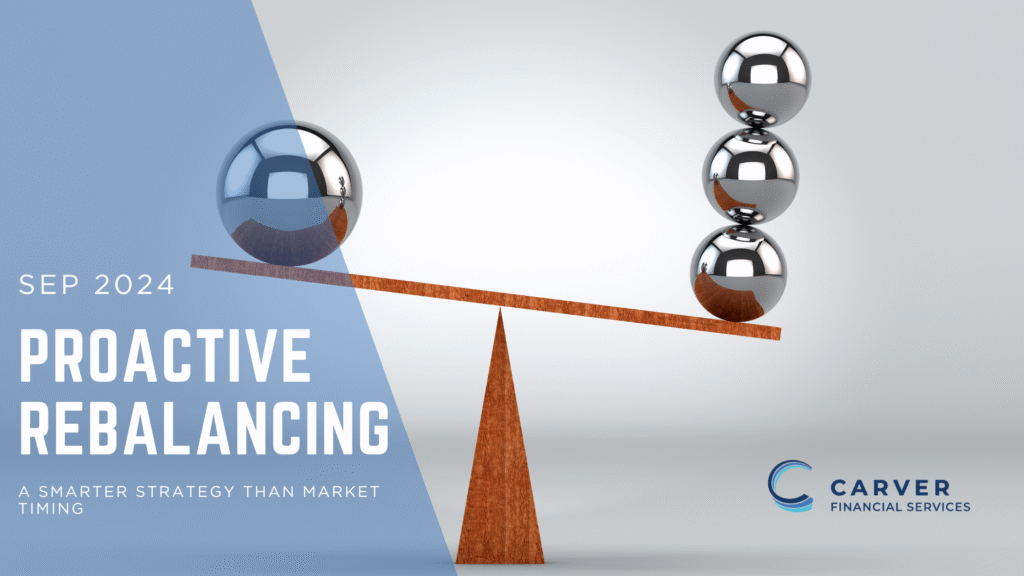
Proactive Rebalancing: A Smarter Strategy Than Market Timing

September 9, 2024 //  by Randy Carver

Why “Timing the Market” Rarely Works

For decades, investors have tried to outsmart the market — selling before downturns and buying before recoveries. The idea sounds appealing: avoid losses and capture gains. But the truth is, market timing doesn’t work consistently. Even professionals rarely get it right.

Trying to predict short-term market movements can lead to missed opportunities, higher fees, and unnecessary taxes — not to mention emotional stress.
At Carver Financial Services, we believe long-term success doesn’t come from predicting the market; it comes from preparing for it.

The Hidden Cost of Market Timing

Market timing is based on the belief that you can accurately forecast future prices — yet global markets are influenced by countless unpredictable factors: economic data, interest rates, elections, and investor sentiment.

Even missing just a few of the market’s best days can devastate long-term returns:

  • 78% of the market’s best days occur during bear markets or in the first two months of recovery.
  • Missing just the 10 best days over 30 years could cut your total return in half.
  • Missing the 30 best days could reduce returns by more than 80%.

That’s because market rebounds often happen fast — and most investors who try to time the market are sitting on the sidelines when those rallies occur.

Emotion plays a major role.
When markets fall, fear drives people to sell. When prices rise, greed tempts them to buy back in — often too late. This reactive cycle leads to underperformance and erodes confidence over time.

The better path? Stay invested — and focus on balance, not prediction.

Why “Buy and Hold” Isn’t Always Enough

The buy-and-hold strategy — purchasing investments and keeping them for the long term — remains a cornerstone of disciplined investing. Over time, markets tend to rise despite short-term volatility.

However, strict buy-and-hold can overlook opportunities to adjust when conditions, tax laws, or your personal goals change.
In a world where algorithms and automated portfolios dominate, too many investors are placed into one-size-fits-all strategies that don’t reflect their unique financial picture.

Your life, goals, and tax situation evolve — and your investment strategy should evolve with them.

The Case for Proactive Rebalancing

Proactive rebalancing is a disciplined yet flexible approach.
Rather than reacting to market swings, it involves regularly reviewing and adjusting your portfolio to keep it aligned with your goals, risk tolerance, and current conditions.

Here’s what makes it so effective:

1. Maintains the Right Risk–Reward Balance

Over time, market performance can shift your portfolio’s weight. Rebalancing brings it back in line — ensuring you’re not taking on too much (or too little) risk.

2. Helps Capture Opportunities

When markets fluctuate, proactive rebalancing allows you to buy undervalued assets and trim overvalued ones — effectively buying low and selling high, but in a disciplined, data-driven way.

3. Enhances Tax Efficiency

Strategic rebalancing can involve realizing losses to offset gains or shifting assets into tax-advantaged accounts. These moves help keep more of what you earn — because in investing, it’s not what you make, it’s what you keep.

4. Adapts to Life Changes

Your financial strategy should reflect where you are today — not where you were five years ago. Rebalancing adjusts for new goals, income changes, or milestones like retirement, ensuring your plan evolves with you.

Investing with Intention, Not Emotion

Investing should support your life — not consume it.
Proactive rebalancing gives you a framework to act rationally, not react emotionally. It replaces guesswork with structure and allows you to focus on what truly matters: having cash flow for today, growth for tomorrow, and confidence for life.

At Carver Financial Services, our dedicated team of professionals integrates proactive rebalancing into every client plan.
We tailor each portfolio to reflect your vision, lifestyle, and tax situation — helping you stay invested, stay balanced, and stay on course.

Conclusion: Prepare, Don’t Predict

Market timing is speculation.
Proactive rebalancing is strategy.

By maintaining diversification, aligning with your long-term goals, and adjusting thoughtfully to change, you can enhance returns, improve tax efficiency, and reduce stress — without ever needing to “call” the market.

Our team is here to help you build a plan designed for real life, not for short-term market noise.
Reach out anytime — we’ll help you create a portfolio that evolves with you and stands the test of time.


Any opinions are those of Randy Carver and not necessarily those of Raymond James. This material is being provided for information purposes only and is not a complete description, nor is it a recommendation. The information has been obtained from sources considered to be reliable, but we do not guarantee that the foregoing material is accurate or complete.

Raymond James and its advisors do not offer tax or legal advice. You should discuss any tax or legal matters with the appropriate professional. Rebalancing a non-retirement account could be a taxable event that may increase your tax liability.
This information is not a statement of all available data necessary for making an investment decision, and it does not constitute a recommendation. All opinions are as of this date and are subject to change without notice. Investing involves risk and you may incur a profit or loss regardless of strategy selected, including asset allocation and diversification. Past performance is not a guarantee of future results.

The S&P 500 is an unmanaged index of 500 widely held stocks that is generally considered representative of the U.S. stock market. Keep in mind that individuals cannot invest directly in any index, and index performance does not include transaction costs or other fees, which will affect actual investment performance. Individual investor’s results will vary.

Category: BlogTag: market timing, Rebalance

Why Invest Beyond Making Money: To Achieve Your Personal Vision

August 1, 2024 //  by Randy Carver

Investing Isn’t Just About Money — It’s About Meaning

Most people think of investing as a way to make money. But the real purpose runs deeper.
At Carver Financial Services, we believe investing is not an end in itself — it’s a means to an end: living the life you envision.

True financial planning is about more than returns or performance charts. It’s about freedom — the ability to make choices that align with your values, goals, and dreams.
That might mean retiring early, helping your children through college, buying a second home, starting a business, or simply living with less worry about the future.

Investing, when done thoughtfully, becomes a tool for achieving independence and peace of mind — not just wealth.

From Financial Planning to Personal Vision Planning®

Our approach, called Personal Vision Planning®, integrates every part of your financial life — investments, tax strategies, estate planning, and asset protection — to create a plan that’s uniquely yours.

We start by understanding your personal vision — what matters most to you — and then build a plan to help you reach it. But creating the plan is just the beginning.
We continually review and update it based on your life changes, new legislation, and market conditions.

That means our team isn’t just managing your money — we’re helping you manage your future.

Why Returns Don’t Tell the Whole Story

When you see an investment’s return, it’s easy to assume that’s the full picture. But returns alone can be misleading.
Two investors might have the same average return — yet one ends up with significantly less money.

Here’s why: sequence of returns and volatility matter.

Imagine investing $100,000.

  • In year one, it drops 50%.
  • In year two, it rises 60%.
    Your average return is +5%, but your ending balance is only $80,000 — not $110,000.

The difference is timing and volatility.

That’s why our focus is on minimizing risk, managing cash flow, and maximizing what you keep — after taxes, fees, and emotions.
Because success isn’t just about growing wealth; it’s about preserving and using it wisely to live the life you envision.

The Deeper Purpose Behind Investing

The question isn’t just how to invest — it’s why you’re investing.
Here are three reasons people invest beyond making money:

1. To Achieve Financial Independence

Investing builds freedom — the ability to make life choices without being limited by money.
Whether that’s retiring early, traveling more, or funding a passion project, independence gives you control over your time and future.

2. To Create Security and Stability

A solid investment strategy safeguards your family’s future — funding education, protecting against inflation, and ensuring a comfortable retirement.
It’s about reducing worry and increasing confidence.

3. To Leave a Legacy

Many investors want their wealth to have impact — supporting future generations, charitable causes, or community initiatives that reflect their values.
Investing with purpose turns wealth into legacy.

Why Long-Term Thinking Wins

Markets rise and fall, headlines change, and emotions fluctuate. But history shows that discipline and time are far more powerful than prediction.

1. Compounding Returns Build Momentum

Compounding — earning returns on past returns — rewards patience. The longer you stay invested, the stronger it becomes.

2. Volatility Is Temporary, Growth Is Enduring

Markets are unpredictable in the short term. But over time, staying invested helps you capture the recovery and long-term growth that impulsive decisions often miss.

3. Personal Goals Take Time

The goals that matter most — funding retirement, raising a family, or building a legacy — aren’t short-term. They require steady, consistent effort across years or decades.

Avoid the Trap of Day-to-Day Watching

In an age of nonstop financial news and real-time data, it’s easy to get caught up in daily market movements. But that constant watching often leads to emotional reactions and stress.

Here’s why stepping back matters:

  • It prevents emotional decision-making.
    Fear and greed are powerful — and reacting to short-term changes can derail long-term plans.
  • It keeps your focus on what truly matters.
    Your goals, not the market, should guide your choices.
  • It reduces stress and improves perspective.
    Financial peace comes from knowing you’re following a plan — not from chasing headlines.

Investing for a Life of Purpose, Not Panic

Investing is about more than numbers — it’s about your why.
When your investments are aligned with your personal vision, every financial decision supports the life you want to live — today and tomorrow.

At Carver Financial Services, we help you look past the noise, manage what you can control, and focus on what truly matters:

  • Minimizing taxes and expenses
  • Managing risk and volatility
  • Aligning wealth with purpose

As election cycles and news cycles intensify, remember — uncertainty is temporary, but your goals are lasting.
Our team is always here to help you stay grounded, focused, and confident in your journey toward financial independence and personal fulfillment.

Investing well means living well — with purpose, clarity, and peace of mind.

Any opinions are those of Randy Carver and not necessarily those of Raymond James. This material is being provided for information purposes only and is not a complete description, nor is it a recommendation. The information has been obtained from sources considered to be reliable, but we do not guarantee that the foregoing material is accurate or complete.

Category: BlogTag: Investing

Protect Your Social Security Payout: Why Early Planning Matters

July 1, 2024 //  by Randy Carver

Planning Ahead for Life’s “What-Ifs”

According to the Alzheimer’s Association, one in three seniors will die with dementia.
It’s a staggering statistic — and when combined with increasing life expectancy, it highlights an urgent truth: we must plan ahead for the possibility of diminished capacity and how it might impact our finances and Social Security benefits.

More than 6.5 million Americans aged 65 and older currently live with Alzheimer’s, and over 11 million provide unpaid care for loved ones affected by dementia.
These realities underscore why preparing early — before health or cognitive decline limits your ability to make decisions — is essential to protect your income, your assets, and your independence.

Why Protecting Your Social Security Benefits Is Critical

Your Social Security payout is a key component of your long-term financial security.
But without proper planning, diminished capacity, disability, or even unexpected medical events could jeopardize your ability to access or manage those benefits effectively.

The good news: With a few important legal and financial safeguards in place — such as powers of attorney (POAs), medical directives, and a representative payee designation — you can protect yourself, your family, and your benefits for the future.

Step 1: Protect Yourself with a Power of Attorney

A power of attorney (POA) is one of the most powerful tools in financial planning for aging adults.
It allows you to appoint a trusted person (known as your agent or attorney-in-fact) to manage your finances, property, or healthcare if you become unable to do so.

There are several types of POAs, each serving a specific role:

  • Conventional (Limited) POA: Grants specific powers for a defined purpose or time.
  • Durable POA: Remains effective even if you become incapacitated — crucial for long-term planning.
  • Springing POA: Takes effect only if a specific event (like incapacity) occurs.
  • Medical POA: Authorizes decisions regarding healthcare and medical treatment.

Having these documents in place ensures that your wishes are followed and your financial life — including your Social Security and investments — remains secure.

Tip: Review and update your POAs regularly as your life circumstances, health, or family dynamics change.

Step 2: Protect Your Adult Children with the Right Documents

Many parents are surprised to learn that once a child turns 18, they are legally considered an adult — and parents lose the automatic right to access their medical or financial information.
That means if your college-aged child were in an accident or hospitalized, privacy laws (like HIPAA) could prevent you from receiving updates or making medical decisions.

The solution:
Set up a durable power of attorney and medical directive for your adult child.
These documents allow you to handle healthcare and legal matters if they’re unable to — ensuring you can step in quickly and legally in an emergency.

Step 3: Protect a Disabled Senior with a Representative Payee

When it comes to Social Security benefits, a power of attorney or guardianship is not always enough.
The Social Security Administration (SSA) requires a special designation — called a Representative Payee — for individuals who can’t manage their benefits on their own.

A Representative Payee:

  • Receives and manages Social Security payments on behalf of another person.
  • Ensures those funds are used exclusively for the beneficiary’s needs (like housing, food, and healthcare).
  • Keeps detailed records for the SSA.

If you believe a loved one may need this support, you can apply through your local Social Security office using Form SSA-11 and provide documentation explaining why the assistance is necessary.

Typically, a family member or trusted friend serves as the payee. If that’s not possible, the SSA can assign a qualified organization.
It’s important to remember that this role only covers the management of Social Security benefits — not medical, legal, or other financial decisions.

Learn more: The SSA provides training videos, downloadable guides, and FAQs at ssa.gov.

Why These Safeguards Matter

Failing to plan ahead can have lasting financial consequences. Without proper legal documents or a designated payee:

  • Benefits can be delayed or mismanaged.
  • Family members may face legal barriers to assisting you.
  • Critical financial decisions could be made by strangers or courts instead of trusted loved ones.

By preparing today, you maintain control over your future — protecting both your income and your independence.

Planning Today for Confidence Tomorrow

Planning for incapacity or long-term care isn’t about expecting the worst — it’s about protecting what you’ve built and ensuring your wishes are honored.

At Carver Financial Services, we guide clients through every stage of this process — from establishing POAs and coordinating with estate attorneys to aligning investment strategies with long-term care needs.
Our goal is to help you preserve the wealth you’ve earned and safeguard your Social Security income for life.

Plan early. Protect what matters. Live with peace of mind.

If you or a loved one need help preparing for the future — or simply want to review your plan — our team is here to help you create a strategy that aligns with your vision and protects your legacy.

Any opinions are those of Randy Carver and not necessarily those of Raymond James. This material is being provided for information purposes only and is not a complete description, nor is it a recommendation. The information has been obtained from sources considered to be reliable, but we do not guarantee that the foregoing material is accurate or complete.

Category: BlogTag: social security

Financial Advice Is Worth the Investment: Why Professional Guidance Pays Off

June 1, 2024 //  by Randy Carver


Financial Advice Is Worth the Investment: Why Professional Guidance Pays Off

The Advice Gap: Why So Many Americans Go It Alone

A recent Allianz study revealed a striking disconnect:
While 88% of Americans believe working with a financial advisor would help them achieve their financial goals — including a more secure retirement — only 44% actually do.
That number has dropped since 2022.

Why the gap?
Many people assume financial advisors are too expensive, think they can manage their finances on their own, or simply haven’t prioritized long-term planning.

But in an age of economic uncertainty and complex tax laws, the cost of not having professional guidance can be far higher than the cost of advice.

DIY Investing vs. Working with a Financial Advisor

The internet has made investing more accessible than ever.
With a few clicks, anyone can open an account, trade stocks, and research funds. This “do-it-yourself” (DIY) approach can seem appealing — especially when avoiding advisor fees appears to save money.

However, what’s often overlooked is the hidden cost of going solo: missed opportunities, unmanaged taxes, emotional decisions, and unnecessary risk.

The Hidden Pitfalls of DIY Investing

  • Lack of structure: Without a financial plan, decisions are often reactive, not strategic.
  • Behavioral bias: Fear and greed can drive impulsive trades.
  • Tax inefficiency: Many DIY investors overlook how to minimize taxes or harvest losses effectively.
  • Missed growth: Not rebalancing or diversifying properly can limit long-term performance.

A National Financial Education Council report found that the average American loses $1,300 per year due to poor financial decisions. For high-net-worth households, the impact is far greater.

Meanwhile, a Vanguard study found that a $100,000 portfolio managed by a professional advisor could grow to $190,000 in 25 years, versus $110,000 under self-management — assuming a 5% return and a 3% annual “advisor value add.”

In short: even after fees, advice often pays for itself many times over.

Beyond Returns: The Real Value of a Financial Advisor

Financial advisors do far more than manage investments.
They help you make smart decisions across every part of your financial life — from taxes and estate planning to insurance, cash flow, and retirement income.

A great advisor acts as your financial partner and behavioral coach, helping you:

  • Avoid costly mistakes during market volatility
  • Maximize after-tax returns
  • Reduce internal portfolio fees
  • Protect assets from lawsuits and creditors
  • Plan for healthcare, college, and long-term care expenses

“The biggest gains often come from what didn’t happen — the taxes avoided, the losses prevented, and the mistakes never made.”

At Carver Financial Services, our advisors have over 300 years of combined experience guiding clients through every kind of financial challenge. That depth of knowledge can’t be replicated by an app or online tutorial.

Wealth Managers vs. Financial Planners: What’s the Difference?

The terms wealth manager, financial advisor, and financial planner are often used interchangeably — but they’re not the same.

Wealth Manager

A wealth manager primarily focuses on investments — managing portfolios to grow assets. Their work typically doesn’t extend to tax strategy, estate planning, or cash flow management.

Financial Planner or Advisor

A financial planner takes a holistic approach, integrating every aspect of your financial life:

  • Tax and estate planning
  • Risk management and insurance
  • Retirement and education planning
  • Income optimization and legacy strategy

At Carver Financial Services, we take this comprehensive approach one step further through our Personal Vision Planning® process — aligning your financial strategy with your life goals, values, and personal vision.

Our mission isn’t just to help you grow wealth; it’s to help you live well — with clarity, purpose, and peace of mind.

Comprehensive Advice Is an Investment in Your Future

Paying for professional advice may feel like an expense — but in reality, it’s an investment in better outcomes.
Most advisors charge 1% or less of your portfolio. Yet, multiple studies show that good advice can add 3% or more in net annual returns through:

  • Tax-efficient investment strategies
  • Behavioral coaching
  • Retirement income planning
  • Cost and fee reduction

Even more valuable is having a trusted professional to call when life changes — from buying a home to inheriting assets to caring for aging parents.

You don’t just gain better numbers on a statement; you gain confidence, time, and peace of mind.

Why Carver Financial Services Is Different

As concert promoter Bill Graham once said of the Grateful Dead:

“They are not the best at what they do — they’re the only ones who do what they do.”

That’s how we see Carver Financial Services.
We’re not just financial planners — we’re a community of experts dedicated to improving every part of our clients’ lives.

In addition to wealth management, we offer:

  • Exclusive client events and educational seminars
  • Travel experiences and networking opportunities
  • Guidance on health, longevity, and lifestyle planning

Our Personal Vision Planning® approach integrates tax, estate, and investment strategies to ensure that your plan evolves with you — helping you lead your best life possible with less stress and more purpose.

The Bottom Line: Financial Advice Pays for Itself

The difference between good advice and going it alone isn’t just measured in dollars — it’s measured in confidence, clarity, and freedom.
Our goal is simple: to help you keep more of what you earn, live the life you envision, and protect what matters most.

There’s no cost or obligation to meet with our team and see if we’re the right fit for you.
At the very least, you’ll gain a second opinion. At best, you’ll gain a lifelong partner in achieving your financial vision.

Financial advice isn’t an expense. It’s an advantage.

Any opinions are those of Randy Carver and not necessarily those of Raymond James. This material is being provided for information purposes only and is not a complete description, nor is it a recommendation. The information has been obtained from sources considered to be reliable, but we do not guarantee that the foregoing material is accurate or complete.

Category: Blog

Understanding the Real Risk: Why Inflation Should Be Your Primary Financial Concern

May 1, 2024 //  by Randy Carver

The Silent Threat Most Investors Overlook

When it comes to financial planning, conversations often center around market volatility, diversification, or asset allocation.
But there’s another, quieter risk that can do far more long-term damage to your wealth: inflation.

Inflation is the gradual increase in prices for goods and services — the silent erosion of your purchasing power. Over time, it makes every dollar you’ve saved worth less.
You may not feel it day-to-day, but it compounds quietly in the background, often posing a greater risk to your financial future than the stock market ever could.

At Carver Financial Services, we believe inflation is the single biggest risk facing most Americans — and that addressing it should be central to every long-term financial plan.

Inflation: A Bigger Threat Than Market Volatility

Many investors fixate on market risk — the fear that their portfolios will decline during downturns.
Yet history shows that inflation can have a more profound and lasting effect on wealth.

Since the mid-1980s, prices for everyday items have more than tripled:

  • A postage stamp cost 22¢ in 1986; today it’s 68¢.
  • A gallon of milk cost $1.08 in 1986; now it’s roughly $3.95.

That means basic goods and services cost three to four times more today. If your investments haven’t grown by at least that much, your purchasing power has declined — even if your portfolio balance looks larger on paper.

Your financial plan shouldn’t just aim for growth. It must also keep pace with inflation and taxes, or your real wealth — what your money can actually buy — will shrink over time.

Why Cash and “Safe” Assets Lose Value Over Time

Many people feel safer keeping large amounts of money in CDs, savings accounts, or cash equivalents. While these may protect you from market swings, they don’t protect you from inflation.

For example, if inflation is 3% per year and your savings account earns 1%, you’re effectively losing 2% in purchasing power annually.
Over a decade, that compounds into a significant loss of value — even without touching the principal.

That’s why investing for growth is essential, even in retirement.
To stay ahead of inflation, your assets must grow faster than the rate at which prices — and taxes — rise.

Investing to Stay Ahead of Inflation

The key to combating inflation is to own assets that can grow over time, not ones that simply hold nominal value. Historically, this includes:

  • Equities (stocks): Offer long-term growth and dividend potential.
  • Real estate: Often rises with or ahead of inflation.
  • Commodities and inflation-protected securities: Provide diversification and potential inflation hedges.

However, every investor’s situation is different.
A 70-year-old retiree needing income will have different needs than a 70-year-old focused on legacy or tax minimization. That’s why your portfolio should reflect your personal vision, tax situation, and stage of life.

At Carver Financial Services, we tailor your investment allocation to balance growth, income, and risk — ensuring your strategy evolves as you do.

Longevity Risk: The Inflation Multiplier

We’re living longer than ever before — which makes inflation’s impact even more powerful.
Longevity risk refers to outliving your money, and it’s a growing concern for retirees.

In 1986, the average life expectancy in the U.S. was 74.8 years.
By 2024, it reached 79.25 years — and many people now live well into their 80s, 90s, or beyond.

That’s potentially 20–30 years of retirement to fund — and decades for inflation to compound.
If your plan assumes outdated lifespans or static expenses, you risk running out of money just when you need it most.

To mitigate this, it’s best to plan for a longer life and higher expenses than you expect. A personalized financial plan can help ensure your income and investments grow with you — not against you.

Financial Planning: Your Best Defense Against Inflation

The most effective way to protect against inflation isn’t guessing the next rate hike — it’s having a comprehensive, adaptable financial plan.

A solid plan includes:

  • A balanced mix of growth and income assets
  • Tax-efficient investing and withdrawal strategies
  • Inflation assumptions built into long-term projections
  • Regular reviews and adjustments for market and life changes

Our team builds each client’s plan with inflation, longevity, and tax erosion in mind — designing strategies that not only preserve wealth but enhance it in real, inflation-adjusted terms.

Your lifestyle shouldn’t shrink as prices rise. Proper planning keeps your future within reach.

The Bottom Line: Focus on What Really Threatens Your Future

Market volatility may dominate headlines, but inflation is the risk that lasts.
By understanding its impact and aligning your investments accordingly, you can protect your purchasing power, maintain your lifestyle, and preserve your legacy.

At Carver Financial Services, our goal is simple: to help you live your best life possible — now and in the future — by building a plan that grows faster than inflation and adapts to whatever life brings.

If you’re concerned about how inflation could affect your retirement, portfolio, or long-term goals, we’re here to help — with no cost or obligation.

Inflation doesn’t stop. Neither should your plan.

Any opinions are those of Randy Carver and not necessarily those of Raymond James. This material is being provided for information purposes only and is not a complete description, nor is it a recommendation. The information has been obtained from sources considered to be reliable, but we do not guarantee that the foregoing material is accurate or complete.

Category: Blog

What’s Really Important? Living with Purpose Beyond Wealth

January 1, 2024 //  by Randy Carver

What’s Really Important? Living with Purpose Beyond Wealth

A New Year, A New Perspective

The New Year is often a time of reflection and goal setting. As we start 2024, we are being inundated with information, the pace of life and of change continues to accelerate and life seems to be more complicated than ever. 

In a world constantly driven by ambition, success and the pursuit of wealth, it’s easy to get lost in the mirage of material riches. Money undeniably holds power and enables a certain level of comfort and security. Yet beneath the surface, there lies a deeper truth: the essence of life transcends just the accumulation of wealth. Our firm is focused on helping people live their best lives — not just accumulate wealth. 

Wealth provides access to opportunities, comforts and a sense of stability. It’s the means to fulfill desires, experience new things and provide for oneself and loved ones. A correlation has been shown between net worth and health. However, pursuing wealth as the sole objective often leads to a tunnel vision that blinds us from the richness of life’s other facets. 

A study conducted jointly by Princeton University and the University of Pennsylvania and published in 2023 found that, on average, higher incomes are associated with ever-increasing levels of happiness. However, the research team found that within that overall trend, an unhappy cohort in each income group shows a sharp rise in happiness up to $100,000 annually and then plateaus. 

The researchers concluded that for most people, higher incomes are associated with greater happiness. The exception is people who are financially well-off but unhappy. In other words, if someone is miserable, more money won’t help. For the least happy group, happiness rises with income until an annual income of $100,000 and then shows no further increase as income grows. For those in the middle range of emotional well-being, happiness increases linearly with income, and for the happiest group, the association actually accelerates above $100,000. 

I have worked in the financial services industry for more than 35 years, with a focus on making people’s lives better. Over these decades, I have seen that in general, when people have a level of wealth that enables them to be free from worry about their cost of living, it creates peace of mind. Beyond a certain level of wealth, however, it’s clear that the happiest people are not the ones with the most material possessions or money.  

True fulfillment emerges from the richness of experiences, relationships, personal growth and the contribution we make to the world. 

  1. Experiences Over Possessions

The memories we create, the experiences we cherish and the moments that take our breath away weave  the true tapestry of our lives. While possessions can bring some joy, what really matters are the experiences that remain with us, and often who we share the experiences with.  Travel, learning, hobbies and adventures offer a wealth of memories and personal growth. 

This is why we started hosting client trips and fun events each year. Our goal is to help people have unique experiences and see new places.  We are building a community of people so that clients meet new friends and enjoy experiences they haven’t had before. You can see full list of upcoming trips and events on our website. 

  1. Relationships and Connections

The depth and quality of our relationships often define our happiness and well-being. The time we spend nurturing friendships, fostering family bonds and building connections within our communities creates a sense of belonging and purpose. These relationships serve as pillars of support during challenging times and amplify our joy during moments of celebration. 

At Carver Financial, we help connect people every chance we get, from Travel Buddies to the parties and trips just mentioned. You can read about the upcoming events on our website, and I am always happy to discuss these with you. 

  1. Personal Growth and Fulfillment

Life’s journey is a canvas for self-improvement and growth. Personal development, pursuing passions and exploring new interests contribute to a sense of fulfillment that transcends just monetary gains. Achieving goals, overcoming obstacles and discovering your true potential add a sense of fulfillment that money alone can’t replicate. 

It’s never too early or too late to acquire new hobbies, interests, or friends.  This is one of the reasons we host unique events and experiences.  

  1. Contributing to a Greater Good

The act of giving, whether through time, resources or expertise, carries immense value. Making a positive impact on the lives of others and contributing to causes larger than oneself creates a profound sense of purpose and fulfillment. The joy derived from helping others and making a difference in the world extends far beyond the boundaries of personal wealth. 

We could not fulfill our firm’s core value of making people’s lives better without the support of our clients. Four initiatives we have launched and maintained to contribute to the greater good are: 

  • In 1990, we launched our initial food drive. Thirty-three years later, the initiative has provided more than 400,000 meals to families in need. 
  • In 1997, we founded the Annual Tim Groves Memorial Charity Golf Event. To date, the event has raised more than $400,000 for local charities, with a focus on helping match those who need bone marrow transplants with donors. 
  • In 2013, we began an initiative called Carver Cares to highlight and support local charitable organizations. The goals are to raise awareness about the services available to the community and to help support the organizations monetarily. At selected events throughout the year, local organizations will provide a brief overview of their mission and services. Our company matches any donations to the highlighted organization — up to $4,000 — made in the month following the event. 
  • In 2023, we launched the New Beginning Initiative. The previous year, I had reflected on the fact that donating food can and has made a difference, yet we were treating only the symptom, not the root cause of hunger or homelessness. The question was, how to do we fix this? The answer was the New Beginning Initiative. 

The New Beginning Initiative is focused on permanently eliminating hunger and homelessness in Lake Country by helping individuals who want to help themselves. This effort focuses on those who want to work rather than giving handouts. This initiative is here to help those individuals work; earn an income to support themselves and their families; and provide dignity, independence and financial freedom. In turn, employment increases in our county. It benefits all of us with better property values, a more robust community and a higher tax base. 

  1. Health and Well-Being

A priceless asset often taken for granted is health — both physical and mental. No amount of wealth can guarantee good health. Investing in self-care, nurturing mental well-being and maintaining a healthy lifestyle are key components of a fulfilling life. Even though a correlation has been shown between better health and net worth in general, there is no guarantee that more wealth will lead to a longer life or better health. Ultimately, it is up to the individual to pursue a healthy lifestyle. 

For most wealth serves as a facilitator rather than the ultimate goal. The pursuit of wealth should ideally align with the pursuit of a life well-lived — one brimming with experiences, meaningful relationships, personal growth, contributions to society and a focus on well-being. This is not easy — if it were, everyone would be happy. 

Life’s true essence lies in finding balance between financial stability and the richness derived from non-material aspects. It’s about appreciating the intangible wealth that surrounds us — the laughter shared, the lessons learned, the love received, and the lives touched. 

Our firm was founded with the idea of making lives better. Our mission involves far more than simply financial planning or growing wealth. We seek to help build a strong, vibrant, well-connected community and enhance each person’s life with experiences, relationships and planning based on their personal vision and values. 

So, as we look forward to the year ahead and navigate an increasingly complex world, let’s remember that while wealth has its place, it’s the richness of life’s other treasures that truly defines the essence of our journey. My team and I wish you all the best for a healthy, happy and fulfilling 2024 and life. Please reach out any time we may be of service in helping you achieve your personal goals or vision and focusing on what’s important.

Any opinions are those of Randy Carver and not necessarily those of Raymond James. This material is being provided for information purposes only and is not a complete description, nor is it a recommendation. The information has been obtained from sources considered to be reliable, but we do not guarantee that the foregoing material is accurate or complete.

Please note, changes in tax laws may occur at any time and could have a substantial impact upon each person’s situation. While we are familiar with the tax provisions of the issues presented herein, as Financial Advisors of RJFS, we do not provide tax or legal advice. You should discuss tax or legal matters with the appropriate professional.

Category: Blog

How the Fed’s interest-rate increases in response to inflation impacts us all

February 13, 2022 //  by Randy Carver

There is a lot of discussion about the Federal Reserve System (the Fed) raising interest rates and speculation on the number of times rates may be increased this year. What are the implications for you, the markets and the economy when rates increase?

What is the Fed?

The Fed is considered the central bank of the United States. It is considered to be one of the most powerful economic institutions in the United States, perhaps the world. Its core responsibilities include setting interest rates, managing the money supply and regulating financial markets. More specifically, it performs five general functions to promote the effective operation of the U.S. economy and, more generally, the public interest. The Federal Reserve’s five-pronged mission is to:

·         Conduct the nation’s monetary policy to promote maximum employment, stable prices and moderate long-term interest rates in the U.S. economy.

·         Promote the stability of the financial system and seek to minimize and contain systemic risks through active monitoring and engagement in the U.S. and abroad.

·         Promote the safety and soundness of individual financial institutions and monitor their impact on the financial system as a whole.

·         Foster payment and settlement system safety and efficiency through services to the banking industry and the U.S. government that facilitate U.S.-dollar transactions and payments.

·         Promote consumer protection and community development through consumer-focused supervision and examination, research and analysis of emerging consumer issues and trends, community economic development activities, and the administration of consumer laws and regulations.

The people who make decisions for the Fed are those who make up the Federal Reserve Board of Governors (Board of Governors), the 12 Federal Reserve Banks (Reserve Banks) and the Federal Open Market Committee (FOMC). The term “monetary policy” refers to the actions undertaken by a central bank, like the Fed, to influence the availability and cost of money and credit to help promote national economic goals. The Federal Reserve Act of 1913 gave the Federal Reserve responsibility for setting monetary policy in the United States.

The Fed’s changes in interest rates impact monetary policy

When the decision makers at the Fed discuss potential rate increases or feel inflation is high or growth is low, they signal, or actually make,  a change in interest rates. This signal, which is simply an announcement of tentative plans to change the rates, can and often does impact markets. This is like when you drive down the road and see a traffic light — green means go, red means stop and yellow means the green light is about to change to red. When the Fed discusses that there is low inflation or growth, it signals that it may lower interest rates. When they discuss inflation, it means they may increase rates.

When the Fed increases interest rates — the cost of borrowing — it makes consumers and companies more cautious about spending. This is how the Fed, in effect, impacts the economy with its decisions about interest rates.

On January 26th, 2022, Jerome H. Powell, the Fed chair, signaled that a rate increase is coming in March. He cited two reasons. First, inflation has been running far above policymakers’ target. In December 2020, inflation increased by 7 percent, the highest annual increase in 40 years. An increased interest rate is expected to bring inflation back down. And second, labor market data suggest that employees are in short supply. Rates have been near-zero since March 2020. Powell did not disclose how many rate increases officials expect to make this year.

By raising interest rates, the Fed is attempting to cool down an economy that is running “too hot.”

The Fed also influences the federal funds rate

The FED also impacts the economy by increasing or decreasing lending rates or reserve requirements of banks.

The Federal Reserve controls the three tools of monetary policy: open-market operations, the discount rate and reserve requirements. The Board of Governors of the Federal Reserve System are responsible for the discount rate and reserve requirements, and the FOMC is responsible for open market operations. Using those three tools, the Federal Reserve influences the demand for, and supply of, balances that depository institutions hold at Federal Reserve Banks and, in this way, alters the federal funds rate. That is the interest rate at which depository institutions lend balances at the Federal Reserve to other depository institutions overnight.

Changes in the federal funds rate trigger a chain of events that affect other short-term interest rates, foreign exchange rates; long-term interest rates; the amount of money and credit; and, ultimately, a range of economic variables, including employment, output and the prices of goods and services.

Two risks to watch out for now

Two of the biggest risks we see for investors today are moving too much money to fixed income due to equity-market volatility and not understanding the impact of inflation, which reduces buying power. These two risks are closely related.

When interest rates rise (often because of increasing inflation), fixed income can lose significant value. We have experienced decreasing interest rates over the past decade that led to stable and often increasing bond prices. As interest rates increase, this trend will reverse; bond prices will decrease.

Inflation reduces buying power, which means a dollar tomorrow will not buy what a dollar today does. As people live longer and do more, it’s critical that their income keep up with inflation. The only way to do this is to own equity. Now, the hottest rate of inflation in four decades, which we just described, has ushered in a wilder era of bond-market volatility, which causes investors to shop for hedges to protect their portfolios.

Economists often measure market volatility using an index called the CBOE (Chicago Board Options Exchange) Volatility Index, called “the VIX.” It represents the market’s expectations for the relative strength of near-term price changes of the S&P 500 index (SPX). It generates a 30-day forward projection of volatility, or how fast prices change. It is an important index in the world of trading and investments because it provides a quantifiable measure of market risk and investors’ sentiments.

As with any index, there is vast fluctuation from one year to the next. For example, as of February 1, 2022, there was a 27.53 percent increase in the VIX. In 2020, there was a 65 percent increase, and in 2018 a 130 percent increase. In 2021, there was a 24 percent decrease in the VIX. In 2019, there was a 45.79 percent decrease, and in 2009, there was a 46 percent decrease.

We will guide you, as always, with prudent long-term planning

Although we can’t predict how many times the Fed may raise interest rates in 2022, the fact is that the amount of increase is more significant than the number of times. For example, three 50 basis point increases (a total of 1.5 percent) is greater than four 25 basis point increases (1 percent). A basis point is 1/100 of 1 percent of interest, or 0.01 percent.

We believe that, as inflation increases, the Fed will continue to signal about interest-rate increases and also increase rates. We could see a “shock and awe” increase, with the smaller increases following. If and when interest rates increase, the prices on long-term bonds will drop.

We believe investors should be cautious about long-term fixed-income holdings and be as intentional about fixed income investing as you are with equities. A properly allocated portfolio, and financial plan, should not depend on speculation. Our process takes into account the fact that we simply don’t know what we don’t know; therefore, we anticipate the unexpected, and we adjust to whatever happens with the Fed, the economy and the markets. We do expect inflation to continue to rise, along with interest rates.

A key to long-term success is taking a proactive approach to monitoring and updating planning and portfolio allocation. This does not mean trying to time markets;  rather it is accounting for economic, tax and personal changes.

We are here to help design, monitor and update your planning. Our team has more than 250 years of combined experience in all market conditions. As we enter a new period of higher inflation, higher interest rates and likely higher taxes, we are here for you. We are happy to answer questions and address any concerns. The current environment will present a good opportunity for those who are prepared to build long-term wealth. Conversely, those who do not have a disciplined and intentional approach may lose significant amounts. As always, your vision is our priority.

________

Randy Carver, CRPC®, CDFA®, is the president and founder of Carver Financial Services, Inc., and is also a registered principal with Raymond James Financial Services, Inc. Randy has more than 32 years of experience in the financial services business. Carver Financial Services, Inc,. was established in 1990 and is one of the largest independent financial services offices in the country, managing $2.2 billion in assets for clients globally, as of December 2021. Randy and his team work with individuals who are in financial transition as a result of divorce, retirement or the sale of a business. You may reach Randy at randy.carver@raymondjames.com.

The information contained in this post does not purport to be a complete description of the securities, markets or developments referred to in this material. The information has been obtained from sources considered to be reliable, but we do not guarantee that the foregoing material is accurate or complete. Any information is not a complete summary or statement of all available data necessary for making an investment decision and does not constitute a recommendation. Any opinions are those of Randy Carver and not necessarily those of RJFS or Raymond James. Expressions of opinion are as of this date and are subject to change without notice.

Category: Blog

  • « Go to Previous Page
  • Page 1
  • Page 2
  • Page 3
  • Page 4
  • Page 5
  • Interim pages omitted …
  • Page 7
  • Go to Next Page »

Footer

Let’s Get Started


We’re ready to help you achieve your vision. Contact our team today.

Contact us

OUR APPROACH
ABOUT US
RESOURCES
EXPERIENCES

CONTACT US

OUR OFFICES
7473 Center St.
Mentor, OH 44060
Phone: 440.974.0808
Toll-Free: 800.627.7279
Email: carverfinancialservices@ raymondjames.com

STAY IN TOUCH
         twitter   

RECOGNIZED BY


(Please click here for award criteria & disclosures.)

Securities offered through Raymond James Financial Services, Inc., member FINRA / SIPC. Investment advisory services offered through Raymond James Financial Services Advisors Inc. Carver Financial Services is not a registered broker/dealer and is independent of Raymond James Financial Services.

Raymond James financial advisors may only conduct business with residents of the states and/or jurisdictions for which they are properly registered. Therefore, a response to a request for information may be delayed. Please note that not all of the investments and services mentioned are available in every state. Investors outside of the United States are subject to securities and tax regulations within their applicable jurisdictions that are not addressed on this site. Contact your local Raymond James office for information and availability.

Links are being provided for information purposes only. Raymond James is not affiliated with and does not endorse, authorize or sponsor any of the listed websites or their respective sponsors. Raymond James is not responsible for the content of any website or the collection or use of information regarding any website’s users and/or members.

Site Footer

Copyright© 2026 · Carver Financial Services · Our Privacy Policy · Member FINRA/SIPC · Legal Disclosures