• Menu
  • Skip to right header navigation
  • Skip to main content
  • Skip to footer

Before Header

440.974.0808

  • Facebook
  • LinkedIn
  • Twitter
  • YouTube

Carver Financial Services

Helping you achieve your personal vision based upon your individual needs, goals and risk tolerance..

  • Our Approach
    • Personal Vision Planning®
    • Wealth Management Services
    • Team Advantage
  • About Us
    • Meet the Team
    • Our History
    • Awards & Recognition
    • Randy’s Story
    • Philanthropy
    • About Raymond James
  • Resources
    • Our Videos
    • Randy’s Blog
    • Raymond James Resources
    • Carver University
    • Resources for Business Owners
    • Client Access Videos
    • Client Communications
    • Seminar Material
    • Carver Financial ROKU® Channel
    • Carver in the News
    • FAQs
    • Carver Merch Store
  • Experiences
    • Our Events
    • Client Getaways
  • Contact Us
  • Client Login

Paige Courtot

Fear Not the Debt Ceiling or Government Shutdowns

May 15, 2023 //  by Paige Courtot


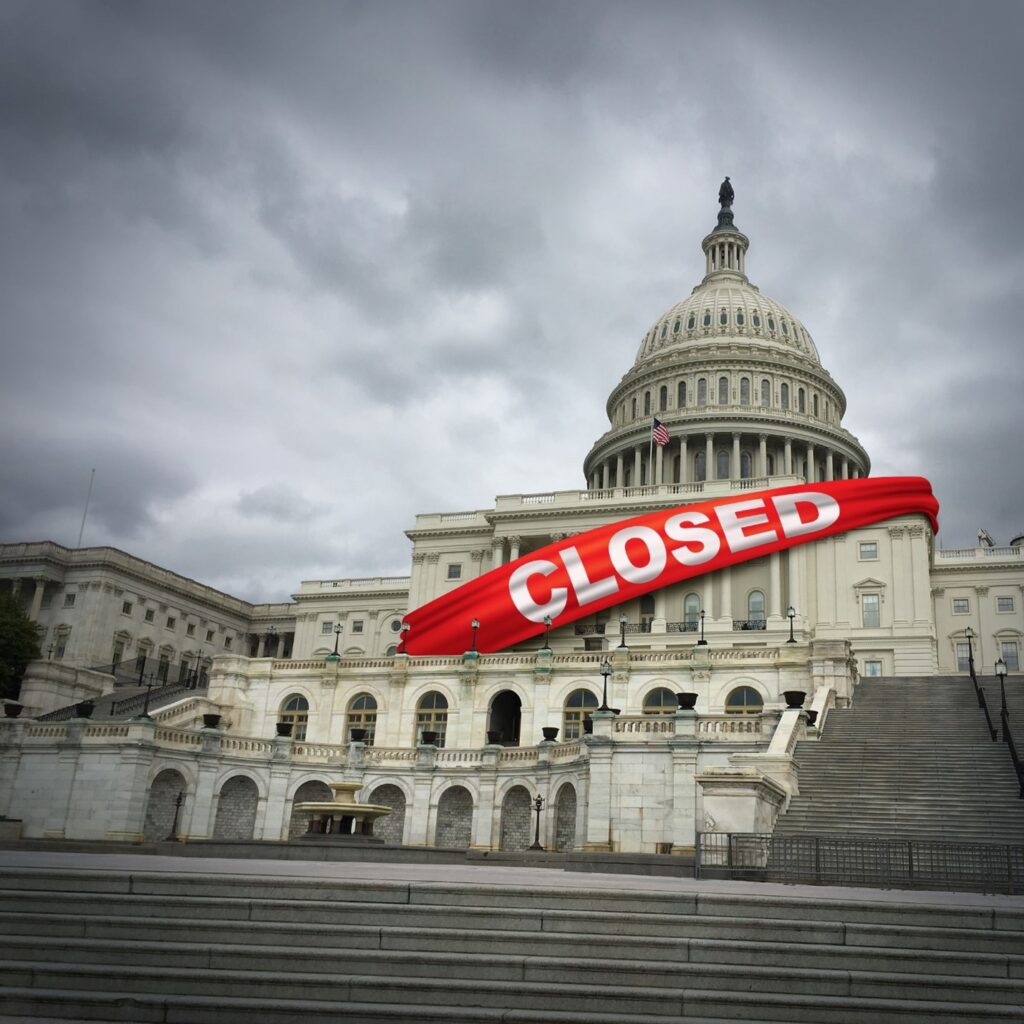
Once again, we are hearing about the need to increase the debt ceiling and a possible government shutdown. These events are not unprecedented, yet for many, the concepts of the debt ceiling and government shutdowns can be confusing and overwhelming. Shutdowns are not uncommon; the U.S. government has shut down a total of 21 times since Congress introduced the Congressional Budget and Impoundment Control Act, which established the federal budget process in 1976.

The debt ceiling is the maximum amount that the government can legally borrow to meet its financial obligations. If Congress fails to approve a budget or continuing resolution, the government must shut down all but essential services. The relationship between these two events is complex, and their impact on the economy can be significant but not unprecedented. These events will have little effect on investors who are well positioned with a good plan.

Increases to the Debt Ceiling: A Brief History

U.S. debt ceilings date back to 1917, but it wasn’t until 1939 that they were codified into law. With the most recent hike in August of 2022, Congress brought the debt ceiling up to a whopping $22 trillion.

In recent years, raising the debt ceiling has become an increasingly divisive political issue, with both parties using it as a negotiation point. In 2011, the United States came perilously close to defaulting on its debt due to the debt ceiling crisis, which resulted in a sharp decline in the stock market and a downgrading of the country’s credit rating.

In 2013, a disagreement over funding for the Affordable Care Act caused a shutdown that lasted for 16 days. As a result of these developments, there have been further calls for the debt ceiling mechanism to be reformed.

Shutdowns in Government: A Brief History

When Congress fails to enact a budget or continuing resolution, the government temporarily stops providing services that aren’t considered essential. The first shutdown happened in 1976, but they’ve been more common as of late.

There have been a total of 21 government shutdowns, with the most recent in December 2018. The shutdown lasted 35 days, from December 22, 2018, to January 25, 2019. It was the longest shutdown in U.S. history. The cause was a disagreement between Congress and the president over funding for a border wall between the United States and Mexico.

When federal workers and contractors aren’t getting paid because of a shutdown, it can have a negative effect on the economy as a whole — and they may impact consumer confidence and be negative fodder for the media — yet shutdowns have historically had little impact on the stock market.

An LPL Financial study that examined stock market activity over 18 government shutdowns, spanning the period from 1976 to 2013, found that shutdowns have had no impact on performance — the median change in the S&P 500 was 0.0 percent. In fact, LPL’s senior market strategist noted that the S&P 500 has actually gained during each of five previous shutdowns.

Our Team Will Help You Prepare and Benefit from Uncertainty

As with any trending event, it’s important to step back and look at facts versus hype. Your financial plan should anticipate periods of volatility — including a government shutdown and/or debt ceiling — and ensure that you have cash to ride them out. Working with an experienced team can help you minimize stress and make decisions logically versus emotionally. With the proper guidance, you may be able to benefit from uncertainly around a debt ceiling debate and/or government shutdown.

We expect to hear the refrain from the media and pundits who are selling everything from newsletters to doomsday supplies that this time it’s different. It’s not. As stated, there have been 21 government shutdowns and virtually no impact on the stock market.

Our team has more than 250 years of combined experience with all kinds of market and economic conditions, including government shutdowns. We will guide you through whatever comes your way. Uncertainly can present an opportunity to benefit in the long run.

Please reach out if you have questions or concerns about current events or your portfolio or if we can otherwise be of service. Your vision is our priority, and your financial well-being is our passion. We look forward to connecting with you.

________

Randy Carver, CRPC®, CDFA®, is the president and founder of Carver Financial Services, Inc., and is also a registered principal with Raymond James Financial Services, Inc. Carver Financial Services, Inc., was established in 1990 with the vision of making people’s lives better — clients, team and community. With this mission, Carver Financial Services has grown to be one of the largest independent financial services offices in the country, managing $2.3 billion in assets for clients globally, as of March 2023. You can reach Randy directly at randy.carver@raymondjames.com and in the office at (440) 974-0808.




Category: Blog

Randy Carver Ranked #65 Among Barron’s 2023 Top 100 Financial Advisors

April 17, 2023 //  by Paige Courtot

April 2023 – Randy Carver, RJFS Registered Principal, and the President of Carver Financial Services, Inc. has been named one of Barron’s Top 100 Financial Advisors in the United States for 2023. Carver placed #65 on the prestigious list, which is compiled based on a rigorous evaluation of various factors such as assets under management, revenue generated, and overall quality of practice. This is the first year Carver has been named to the list. 

Carver has been a financial advisor for over 30 years and has consistently been recognized for his expertise in the industry. He specializes in developing customized investment strategies that align with his clients’ long-term goals and risk tolerance.

Upon receiving the news of his latest achievement, Carver expressed his gratitude to his clients and team, saying, “I am honored to be recognized by Barron’s, but this would not have been possible without the trust and support of my clients and the hard work of my team at Carver Financial Services. We remain committed to providing the highest level of service and guidance to help our clients achieve their financial objectives.”

Carver’s inclusion on the list highlights his commitment to excellence and his ability to deliver results for his clients. As one of the top financial advisors in the country, he is poised to continue making a significant impact in the financial industry for years to come.

Visit here to see Randy’s Profile.

Barron’s is a registered trademark of Dow Jones & Company, L.P. All rights reserved. The rankings are based on data provided by 961 individual advisors and their firms and include qualitative and quantitative criteria. Data points that relate to quality of practice include professionals with a minimum of 7 years financial services experience, acceptable compliance records (no criminal U4 issues), client retention reports, charitable and philanthropic work, quality of practice, designations held, offering services beyond investments offered including estates and trusts, and more. Financial Advisors are quantitatively rated based on varying types of revenues produced and assets under management by the financial professional, with weightings associated for each. Investment performance is not an explicit component because not all advisors have audited results and because performance figures often are influenced more by clients’ risk tolerance than by an advisor’s investment picking abilities. This ranking is based upon the period from 12/31/2021 to 12/31/2022 and was released 4/14/2023. This ranking is not based in any way on the individual’s abilities in regards to providing investment advice or management. The ranking may not be representative of any one client’s experience, is not an endorsement, and is not indicative of an advisor’s future performance. Neither Raymond James nor any of its Financial Advisors pay a fee in exchange for this award/rating. Barron’s is not affiliated with Raymond James.

Please visit https://www.barrons.com/advisor/report/top-financial-advisors/independent for the full story.

Category: Awards

Bank Collapses… and Opportunities

April 1, 2023 //  by Paige Courtot

Between March 8thand March 12th, 2023, three large U.S. banks failed, generating a lot of media attention. Many pundits wrote about the pending collapse of the U.S. banking system and dire consequences for the stock markets. Some compared this situation to the 2008 bankruptcy of Lehman Brothers on September 15th, 2008, and the beginning of the Great Recession.

As they always do, prognosticators are claiming that this time, it’s different — they say that this time, we’re in real trouble. But this time isn’t different. We are not in trouble! The truth is, although the nature of risks and market downturns changes through the years, we can always prevail simply by having a sound financial plan in place, keeping some cash reserves available and staying the course.

You can almost always find opportunity within a crisis.

About the recent bank collapses

To put this in context here is an overview of the three bank collapses that occurred in the second week of March 2023:

  • On March 8th, Silvergate, a California-based bank that made loans to cryptocurrency companies, announced that it would cease operations. Silvergate catered largely to cryptocurrency companies, including the failed exchange FTX. The media generally ignored the fact that this was a very niche situation.
  • On March 10th, Silicon Valley Bank (SVB) was placed into Federal Deposit Insurance Corp. (FDIC) receivership. After prominent venture capitalists, including those from Peter Thiel’s Funders Fund, told customers to pull their deposits out of the bank, SVB was hit with a wave of requests for cash. By the end of the day on Thursday, March 9th, depositors withdrew more than $42 billion. This was another unique situation.
  • On March 12th, state regulators closed New York-based Signature Bank, the 16th-largest lender in the United States. A sudden and unexpected onslaught of customer withdrawals erased more than $100 billion in market value from U.S. banks. The FDIC took control of Signature, which had $110.36 billion in assets and $88.59 billion in deposits at the end of 2022, according to New York state’s Department of Financial Services.

Later on March 12th, the U.S. Treasury, Federal Reserve and FDIC issued a joint statement saying that all the depositors of Signature Bank and Silicon Valley Bank would be made whole and announced actions to shore up deposits to try to prevent further fallout.

Yet no depositors have lost any funds, and again, Silvergate and Silicon Valley were niche situations and not indicative of the overall banking climate.

Avoid reacting to media reports

As we have said for three decades, the media often offer incomplete information, with a bias toward the negative and short-term aspects. This type of attention can create unnecessary anxiety and drops in markets, which cause many people concern. However, we believe market downturns provide a great opportunity for long-term investors.

We have seen this repeatedly — those who take advantage of dips benefit, while those who panic and/or sell permanently lose wealth. The key to be in a position where you do not need to sell. As always, we recommend having cash reserves and/or fixed income to cover 9 to 12 months of your family’s needs. Currently, there are some relatively high rates available for cash and cash equivalents, with money markets yielding 4.5% or greater!

When the markets take a tumble, it’s not all bad news. Some sectors of the economy actually tend to outperform others as consumer needs shift. These include health care and consumer staples stocks (or funds tracking those sectors), large-cap stocks and income investments.

Market volatility is normal and expected, contrary to media focus. Since 1928, this country has seen a market drop of 5 percent about every 2 months, on average; 10 percent about every 8 months; and 20 percent every 30 months.

Keep in mind that the media will often talk about a “points drop,” not a “percentage drop,” and as the markets move higher, this is more dramatic. For example, in June 2018, the Dow was at 24,000, so a 10 percent swing would be 2,400 points. Today, with the DOW at 32,000, a 10 percent swing is 3,200 points. Given the bank issues this month, the market moved a few hundred points, which is still relatively insignificant.

Have a good plan in place to avoid locking in losses

The key to building wealth is to avoid locking in losses. By having a good plan and good cash reserve you should never have to sell.

Here are some of the biggest news topics from 1981 through 2021:

1981    Beginning of steep recession

1982    Worst recession in 40 years

1983    Market hits new highs

1984    Record federal deficits

1985    Economic growth slows

1986    Dow nears 2000

1987    Record-setting market decline

1988    Iran hostage crisis

1989    October “mini-crash”

1990    Persian Gulf War

1991    Fall of the Berlin Wall

1992    Global recession

1993    Health-care reform

1994    Fed raises interest rates six times

1995    Dow tops 5,000

1996    Dow tops 6,000

1997    Hong Kong reverts to China

1998    Asian Flu outbreak

1999    Y2K scare

2000    Tech bubble bursts

2001    Terrorist attacks on US soil

2002    Corporate accounting scandals

2003    Invasion of Iraq

2004    Rise in interest rates

2005    Gulf hurricanes

2006    North Korean testing of nuclear missiles

2007    The Chinese correction

2008    Beginning of the global financial crisis

2009    U.S. unemployment rate exceeds 10 percent

2010    BP oil spill

2011    The European PIGS debt crisis

2012    Falling off the U.S. fiscal cliff

2013    Boston Marathon bombing

2014    Ebola outbreak in West Africa

2015    The Paris attacks and U.S. mass shootings

2016    Donald Trump or Hillary Clinton

2017    North Korean nuclear testing

2018    Beginning of the US–China trade war

2019    Trump’s quid pro quo impeachment

2020    COVID-19

2021    Border crisis

2022    Russia’s invasion of Ukraine

If someone who turned 65 years old at the end of 2021 had invested $10,000 in the S&P 500 at the age of 25 on January 1, 1981, he or she would have $963,427, despite all the issues with markets, the economy and in the media. During that time, there were a lot of reasons to panic and to avoid investing. Yet those who did invest, and who ignored the negativity and stayed the course, fared well.

From March 1, 2012, to March 1, 2023, the Dow moved from 13,142 to 32,652 — a gain of 148 percent- despite all the issues.

Whether it’s a bank collapse, an international crisis or some other upheaval, you can weather the storm by being prepared and working with your financial advice team on the best strategies to take. Yes, the nature of crises will always vary, but one thing will never change: savvy investors can find opportunity within the upheavals.

We will guide you in taking a disciplined approach

There have always been — and most likely will always be — reasons not to invest and reasons to panic. Yet with a disciplined approach, you can not only manage these situations but benefit from them. While the events change, the ideal reactions are the same, as are the opportunities. We recognize that, although this is simple in theory, it is difficult in practice. That’s why we are here for you.

Our team has more than 250 years of combined experience with all kinds of market and economic conditions. We will guide you through whatever comes our way. Please reach out if you have questions or concerns or if we can otherwise be of service. There are potential pitfalls in building wealth today, yet there are also tremendous opportunities. Your vision is our priority, and your financial well-being is our passion.  We look forward to connecting with you.


Holding investments for the long term does not insure a profitable outcome. Investing involves risk and you may incur a profit or loss regardless of strategy selected, including diversification and asset allocation.

Keep in mind that individuals cannot invest directly in any index, and index performance does not include transaction costs or other fees, which will affect actual investment performance. Individual investor’s results will vary. Past performance does not guarantee future results.

Randy Carver, CRPC®, CDFA®, is the president and founder of Carver Financial Services, Inc., and is also a registered principal with Raymond James Financial Services, Inc. Carver Financial Services, Inc. was established in 1990 with the vision of making people’s lives better — clients, team and community. With this mission, Carver Financial Services has grown to be one of the largest independent financial services offices in the country, managing $2.2 billion in assets for clients globally, as of December 2022. Randy and his team work with individuals who are in financial transition as a result of divorce, retirement or the sale of a business. You may reach Randy directly at randy.carver@raymondjames.com in the office at (440) 974-0808.



Category: Blog

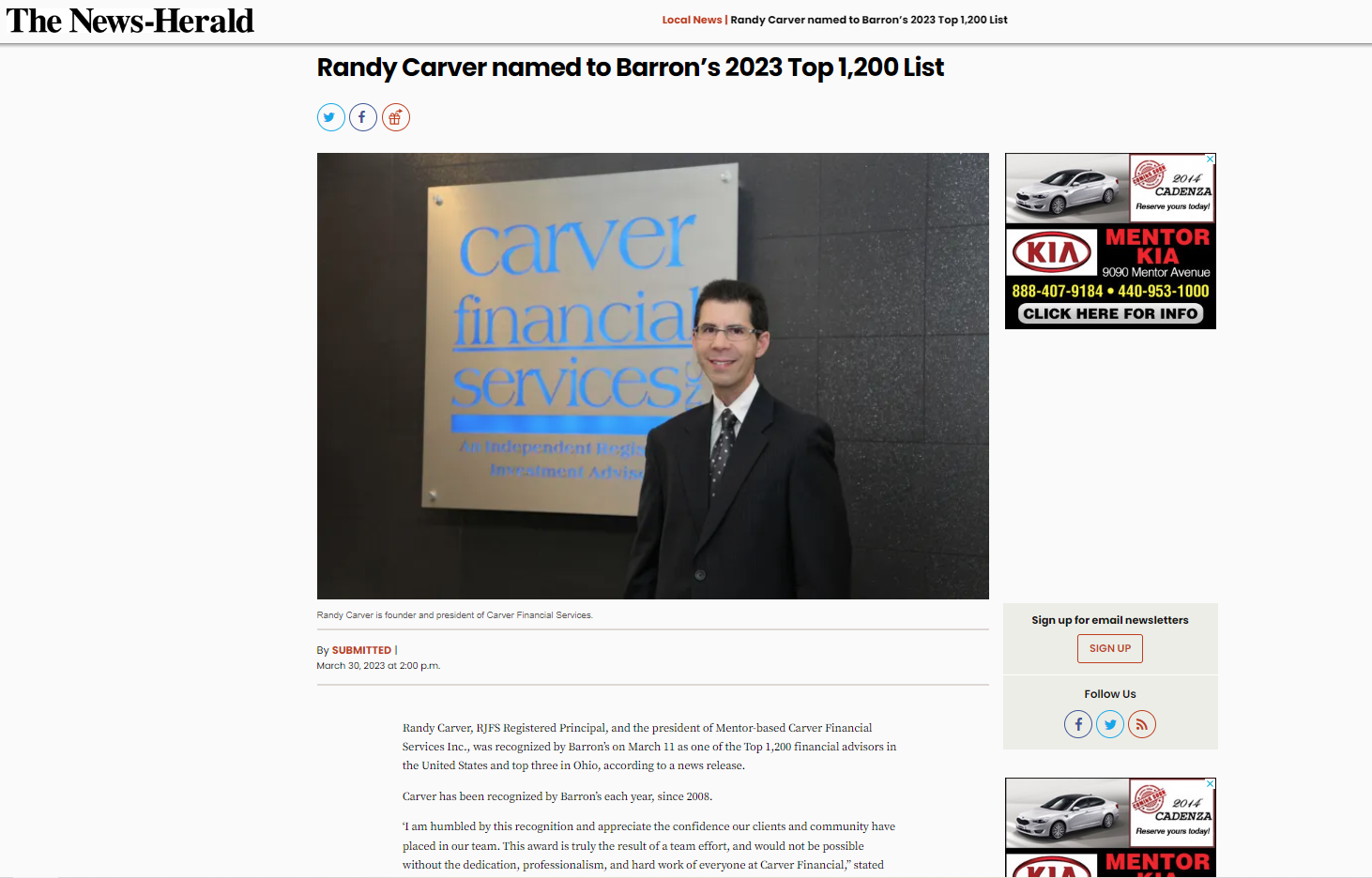
The News Herald recognizes Randy Carver

March 31, 2023 //  by Paige Courtot

Click to read full article


Category: Media

Randy Carver named to America’s Top 250 Wealth Advisors in 2023 by Forbes

March 28, 2023 //  by Paige Courtot

April 4th, 2023 –Randy Carver, RJFS Registered Principal, and President of Carver Financial Services Inc., was named to Forbes’ 2023  “America’s Top Wealth Advisors” list. There were 39,007 nominations with 250 advisors receiving the award. Randy placed 99th out of 250 in America. This is the second consecutive year that Carver has been recognized by Forbes on this prestigious list of elite wealth advisors.

“It’s an honor to be on this prestigious list.  This inclusion would not be possible without the support of our clients and the professionalism of our entire team; both of which I am appreciative of and humbled by,” commented Randy Carver. 

The Forbes Top Wealth Advisors List highlights top advisors across the country who are researched, interviewed, and assigned a ranking within their respective states and markets.

2023 Forbes America’s Top Wealth Advisors, developed by Shook Research, is based on the period from 6/30/2021 to 6/30/2022 and was released on 4/4/2023. 39,007 nominations were received and 250 advisors won. Neither Raymond James nor any of its advisors pay a fee in exchange for this award. More: https://go.rjf.com/432ppOn. Please see https://www.forbes.com/top-wealth-advisors for more info.

Category: Awards

Tax-Exempt Investing

March 27, 2023 //  by Paige Courtot

As the April tax filing deadline looms, many people are thinking about the taxes they will have to pay. This is a good time to consider if tax-exempt investments make sense for you.

This is a good time to consider if tax-exempt investments make sense for you.

Category: Video

Barron’s names Randy Carver to its Top 1200 Financial Advisors List for 2023

March 13, 2023 //  by Paige Courtot

March 16, 2023 – Barron’s Magazine named Randy Carver, RJFS Registered Principal and President of Carver Financial Services, as one of the top advisors in the Nation and ranked third for the state of Ohio. Randy has been recognized by Barron’s every year since 2008.

Rankings are based on data provided by the nation’s 6,000 most productive advisors. Factors included in the rankings: assets under management, revenue produced for the firm, regulatory record, quality of practice and philanthropic work. Investment performance isn’t an explicit component because not all advisors have audited results and because performance figures often are influenced more by clients’ risk tolerance than by an advisor’s investment-picking abilities. Barron’s listed their top 1,200 putting Randy in the top 4/10th of 1% of all advisors.

To see the full listing click here.

Barron’s is a registered trademark of Dow Jones & Company, L.P. All rights reserved. The rankings are based on data provided by 5,630 individual advisors and their firms and include qualitative and quantitative criteria. The time period upon which the rating is based is from 09/30/2021 to 09/30/2022, and was released on 03/15/2023. Factors included in the rankings: assets under management, revenue produced for the firm, regulatory record, quality of practice and philanthropic work. Investment performance is not an explicit component because not all advisors have audited results and because performance figures often are influenced more by clients’ risk tolerance than by an advisor’s investment picking abilities. The ranking may not be representative of any one client’s experience, is not an endorsement, and is not indicative of advisor’s future performance. Neither Raymond James nor any of its Financial Advisors pay a fee in exchange for this award/rating. Barron’s is not affiliated with Raymond James.


Category: Awards

This Time It’s Different – Bank Collapse and Opportunity

March 8, 2023 //  by Paige Courtot

Whether it’s a bank collapse, an international crisis or some other upheaval, you can weather the storm by being prepared and working with your financial advice team on the best strategies to take. Yes, the nature of crises will always vary, but one thing will never change: savvy investors can find opportunity within the upheavals.


Category: Video

Tax-Exempt Investing: It’s Not What You Make, It’s What You Keep

March 1, 2023 //  by Paige Courtot

As the April tax filing deadline looms, many investors are thinking about the taxes they will have to pay. In the end, though, it’s not what you make that’s important, but what you keep — net of fees, expenses and income tax. Investing in tax-exempt investments can reduce or eliminate your income tax and may provide you with higher net returns than taxable investments.

If you are in a higher tax bracket for federal and/or state tax, a lower tax-exempt yield can provide you with more net income than a higher taxable investment. For example, if you are in the 32 percent federal tax bracket, a 5 percent tax-exempt investment is equivalent to a 7.35 percent taxable investment. In general, the higher your tax bracket, the more you can benefit from tax-efficient investing.

Used properly, with the guidance of your advisory team, tax-exempt investments may provide you with significantly more net return. Managing your tax burden is one of the most valuable benefits you derive from working with our team.

Let’s look at five of the most common financial avenues that enable investors to take advantage of tax-exempt investing.

1. Municipal bonds

Municipal bonds, also known as munis, are debt instruments issued by states and local governments that allow investors to earn interest without having to pay income taxes on the proceeds. Investing in munis can be an effective way for individuals to reduce their overall income tax burden because income is not subject to tax.

Investors can buy the bonds themselves or can buy pooled investments such as mutual funds, unit trusts or exchange-traded funds (ETFs).

Some experts say 2023 looks to be a great year for munis, which is great news because 2022 was a tough year for many  fixed-income asset classes. Yields are now higher for muni bonds than at any other time in the past 15 years. While past performance doesn’t guarantee future results –  dating back to 1989, a down year in the municipal bond market has been followed by at least one year (or several) of positive returns.

2. 529 plans

Another type of tax-exempt investing is a 529 plan, which is a state-sponsored educational savings plan that offers tax benefits when the funds are used for qualified education expenses. Investments in these plans may also offer a deduction on your state tax return.

3. Health savings accounts

Health savings accounts, or HSAs, are the only type of account that offers triple tax benefits. Many medical insurance plans and policies with high deductibles make the insured eligible for contributions to HSAs.

Contributions up to an annual limit are tax-deductible when you make them and are excluded from your gross income when your employer makes them. The account can be invested, and the earnings compound tax-free in the account. Also, distributions from an HSA are tax-free when they are used to pay for or reimburse you for qualified medical expenses that aren’t reimbursed by other sources. Plus, if you incurred unreimbursed medical expenses in earlier years, the HSA can reimburse you for them in the current year, tax-free. Talk to your advisor about moving money from a taxable financial account to an HSA.

4. Employer-sponsored retirement plans

If you work for a company that offers a ROTH  401(k) retirement savings plan, consider maxing out the contributions you make to your account, if you aren’t already doing so, because you can make the contributions on a pretax basis.  Funds grow without tax and all earnings may be tax free if taken after the age of 59 ½.  

5. Long-term capital gains

Investment taxes, called capital gains, come in both long-term and short-term categories. A long-term capital gain is a tax on any investment you’ve held for at least one year, while short-term capital gains are those assessed on investments you’ve held for less than a year.

If you can reach the long-term threshold, your tax treatment will be significantly better. This is because short-term capital gains taxes are levied based on normal income tax brackets, while long-term capital gains have much lower rates of 0 percent, 10 percent, 15 percent, or 20 percent.

________

Overall, tax-exempt Investing can be an effective way for individuals to reduce their overall income tax burden. By investing in the products discussed here, you can maximize the amount of money you keep for yourself. These types of investments can also provide a stable stream of income with minimal risk.

Yes, “the tax man cometh,” as the old saying goes, but with the proper planning, you can pay “the tax man” less and keep more for yourself!

We Are Always Here for You

Investing in tax-exempt, or tax advantaged investments can be a great way to minimize your income tax liability and put more money in your pocket. However, it is important to understand the different types of investments available and the associated risks. Also, it’s important to remember that the tax benefits of these investments can vary depending on your particular tax situation. As such, it is always wise to consult with a qualified tax advisor before making any investment decisions.

Our team focuses on helping you achieve your vision in the most tax-efficient manner possible. While we can’t control markets, we often can control the tax implications of portfolio management.

Whether you would like a second opinion on what you are doing or need help designing a new financial plan, please reach out to us, without cost or obligation.

________

Randy Carver, CRPC®, CDFA®, is the president and founder of Carver Financial Services, Inc., and is also a registered principal with Raymond James Financial Services, Inc. Carver Financial Services, Inc. was established in 1990 with the vision of making people’s lives better — clients, team and community. With this mission, Carver Financial Services has grown to be one of the largest independent financial services offices in the country, managing $2.2 billion in assets for clients globally, as of December 2022. Randy and his team work with individuals who are in financial transition as a result of divorce, retirement or the sale of a business. You may reach Randy directly at randy.carver@raymondjames.com in the office at (440) 974-0808.



Category: Blog

Attitude and Investing

February 22, 2023 //  by Paige Courtot

Just when it starts feeling like the world is going down the tubes, Nik Wearsch gives his take on what we take time to notice.

Category: Video

  • « Go to Previous Page
  • Page 1
  • Interim pages omitted …
  • Page 10
  • Page 11
  • Page 12
  • Page 13
  • Page 14
  • Interim pages omitted …
  • Page 34
  • Go to Next Page »

Footer

Let’s Get Started


We’re ready to help you achieve your vision. Contact our team today.

Contact us

OUR APPROACH
ABOUT US
RESOURCES
EXPERIENCES

CONTACT US

OUR OFFICES
7473 Center St.
Mentor, OH 44060
Phone: 440.974.0808
Toll-Free: 800.627.7279
Email: carverfinancialservices@ raymondjames.com

STAY IN TOUCH
         twitter   

RECOGNIZED BY


(Please click here for award criteria & disclosures.)

Securities offered through Raymond James Financial Services, Inc., member FINRA / SIPC. Investment advisory services offered through Raymond James Financial Services Advisors Inc. Carver Financial Services is not a registered broker/dealer and is independent of Raymond James Financial Services.

Raymond James financial advisors may only conduct business with residents of the states and/or jurisdictions for which they are properly registered. Therefore, a response to a request for information may be delayed. Please note that not all of the investments and services mentioned are available in every state. Investors outside of the United States are subject to securities and tax regulations within their applicable jurisdictions that are not addressed on this site. Contact your local Raymond James office for information and availability.

Links are being provided for information purposes only. Raymond James is not affiliated with and does not endorse, authorize or sponsor any of the listed websites or their respective sponsors. Raymond James is not responsible for the content of any website or the collection or use of information regarding any website’s users and/or members.

Site Footer

Copyright© 2026 · Carver Financial Services · Our Privacy Policy · Member FINRA/SIPC · Legal Disclosures