
• Menu
  • Skip to right header navigation
  • Skip to main content
  • Skip to footer

Before Header

440.974.0808

  • Facebook
  • LinkedIn
  • Twitter
  • YouTube

Carver Financial Services

Helping you achieve your personal vision based upon your individual needs, goals and risk tolerance..

  • Our Approach
    • Personal Vision Planning®
    • Wealth Management Services
    • Team Advantage
  • About Us
    • Meet the Team
    • Our History
    • Awards & Recognition
    • Randy’s Story
    • Philanthropy
    • About Raymond James
  • Resources
    • Our Videos
    • Randy’s Blog
    • Raymond James Resources
    • Carver University
    • Resources for Business Owners
    • Client Access Videos
    • Client Communications
    • Seminar Material
    • Carver Financial ROKU® Channel
    • Carver in the News
    • FAQs
    • Carver Merch Store
  • Experiences
    • Our Events
    • Client Getaways
  • Contact Us
  • Client Login

Paige Courtot

Inflation — A Real Risk, Whatever the Real Number

May 2, 2022 //  by Paige Courtot

“It’s the economy, stupid” was a phrase coined by James Carville in 1992, when he was advising Bill Clinton in his successful run for the White House.

In 1992, the United States was experiencing an economic recession, and the incumbent president, George H. W. Bush, was perceived as being out of touch with the needs of ordinary Americans. Carville told campaign staffers to hammer on the importance of the economy at every chance they got. He even went so far as to hang a sign in campaign headquarters reading, in part, “the economy, stupid.”

Today the issue is inflation. As with most topics that become political, there is a lot of misinformation, incomplete information or simply misunderstanding.

How experts measure the economy

The government uses several indexes to measure the economy. None of them are perfect, and they all measure different components of the economy.

One of the main measures economists use is the Consumer Price Index, or CPI, which measures the change in prices consumers pay for goods and services. The CPI reflects spending patterns for each of two population groups: all urban consumers and urban wage earners and clerical workers. The all urban consumer group represents about 93 percent of the total U.S. population.

As of March 2022, the CPI was up 8.5 percent from a year earlier before seasonal adjustment, the highest since 1981. Politicians blame the Ukraine war, supply-chain issues and COVID, among other factors. The simple explanation is just too much money chasing too few goods. The record amount of government spending over the past two years, combined with a decrease in energy production, is the root cause.

Another common measure of the economy is the PPI (Producer Price Index), which measures the average change over time in the selling prices received by domestic producers for their output. A third measure is the PCE (personal consumption expenditures price index, sometimes called the “PCE deflator.” PCE measures the prices that people living in the United States, or those buying on their behalf, pay for goods and services.

The inputs and methods to make these calculations are publicly available. There is not a conspiracy to dupe the American people in this regard. Whichever measure you use, every government measure of inflation is up. To see this, you don’t have to be an economist — just someone who shops!

Some people believe inflation is “transitory” and will be temporary. They point to core inflation, which is the change in the costs of goods and services, excluding those from the food and energy sectors because the prices of these items are much more volatile. Core inflation is up 6.4 percent versus a year ago, the highest since August 1982. There is a reason to exclude some prices when there are very special factors at play…but food and energy prices have been going up for more than a year.

Measuring the money supply

Economists also monitor measures of the money supply, including M1 and M2.

M1 is the money supply that is composed of currency, demand deposits and other liquid deposits, including savings deposits. M1 includes the most liquid portions of the money supply because it contains currency and assets that either are or can be converted to cash quickly.

In contrast, M2 is a broader money classification than M1 because it includes assets that are highly liquid but are not cash. Individuals and businesses typically don’t use savings deposits and other non-M1 components of M2 when they make purchases or pay bills but could convert them to cash relatively quickly. Economists like to include the more broadly defined definition for M2 when discussing the money supply because modern economies often involve transfers between different account types. For example, if you transfer $10,000 from a money market account to a checking account, the transfer increases M1 and keeps M2 stable because M2 contains money market accounts.

Just because more of the inflationary impact of the surging M2 measure of money (up more than 40 percent since the start of COVID) shows up in food and energy prices, or even used-car prices, isn’t a reason not to count them.

Shadowstats proponents inflate inflation even further

Some people claim that the government is grossly underestimating inflation and is hiding the scope of the problem. If you go online, you can see some people suggesting that if we used the pre-1980 methodology to measure inflation, it’s already running north of 15 percent. A website called Shadow Government Statistics presents the theory that the Bureau of Labor Statistics made a series of methodological changes in the 1980s and 1990s that have systematically understated the true rate of inflation. These Shadowstats proponents say the true inflation rate is 6 to 8 percentage points higher than the official statistics indicate.

Using pre-1980 numbers makes it appear that inflation has been running close to 10 percent per year, on average, since 2000. But if inflation really had been running close to 10 percent per year, the cost of goods and services would have gone up 800 percent since 2000. This simply hasn’t happened. In 2000, a gallon of milk cost $2.79, a Big Mac was $3.99 and the average new car cost $21,850. Today, milk does not cost $22 per gallon, a Big Mac does not cost $31 and the average new car is not $174,800. Moreover, if this methodology were a true measure of real GDP growth, the United States would have been in recession since 2000. This simply isn’t the case.

Whatever the actual number is, inflation is a big risk

Regardless of what the inflation number is, we believe inflation remains one of the biggest risks that people face in retirement — especially those who are on a fixed income. One challenge for retirees is stretching a fixed income to meet rapidly rising prices. Another is investing in a way that helps retirees keep pace with the higher cost of living.

Their income will not (by definition) keep up with rising costs. This is why it’s so important to continue to invest so you can grow assets, even once you are retired. People are living longer and doing more, so growing your wealth is critical. Just as the old rules for calculating inflation don’t make sense, old rules for investing don’t either. Today it’s important to allocate your portfolio based on both your current needs and your future needs, so you don’t outlive your money.

As we approach the midterm elections, we will hear more about inflation — because “it’s the economy, stupid.” One doesn’t have to be an economist to know prices are going up. Moreover, the important thing is not what the economic numbers say, but how you are personally impacted.

Our team is here to help you develop a long-term plan to meet your needs and wants today, while doing the same in the future. Smart investing is a dynamic and lifelong process. Feel free to reach out whenever we may be of service. Your vision is our priority, and your future is our mission.

________

Randy Carver, CRPC®, CDFA®, is the president and founder of Carver Financial Services, Inc., and is also a registered principal with Raymond James Financial Services, Inc. Randy has more than 32 years of experience in the financial services business. Carver Financial Services, Inc,. was established in 1990 and is one of the largest independent financial services offices in the country, managing $2.2 billion in assets for clients globally, as of December 2021. Randy and his team work with individuals who are in financial transition as a result of divorce, retirement or the sale of a business. You may reach Randy at randy.carver@raymondjames.com.

The information contained in this post does not purport to be a complete description of the securities, markets or developments referred to in this material. The information has been obtained from sources considered to be reliable, but we do not guarantee that the foregoing material is accurate or complete. Any information is not a complete summary or statement of all available data necessary for making an investment decision and does not constitute a recommendation. Any opinions are those of Randy Carver and not necessarily those of RJFS or Raymond James. Expressions of opinion are as of this date and are subject to change without notice.

Returns are based on the S&P 500 Total Return Index, an unmanaged, capitalization-weighted index that measures the performance of 500 large capitalization domestic stocks representing all major industries. Indices do not include fees or operating expenses and are not available for actual investment. The hypothetical performance calculations are shown for illustrative purposes only and are not meant to be representative of actual results while investing over the time periods shown. The hypothetical performance calculations are shown gross of fees. If fees were included, returns would be lower. Hypothetical performance returns reflect the reinvestment of all dividends. The hypothetical performance results have certain inherent limitations. Unlike an actual performance record, they do not reflect actual trading, liquidity constraints, fees and other costs.

Also, because the trades have not actually been executed, the results may have under- or overcompensated for the impact of certain market factors such as lack of liquidity. Simulated trading programs in general are also subject to the fact that they are designed with the benefit of hindsight. Returns will fluctuate and an investment upon redemption may be worth more or less than its original value. Past performance is not indicative of future returns. An individual cannot invest directly in an index.

Category: Blog

7 Ways Being Too Analytical Can Cause You to Miss Opportunities

May 1, 2022 //  by Paige Courtot

One observation I’ve made after more than 30 years working in the Financial Services industry is that not all smart people are successful investors. Many people are very analytical, and while this quality serves them well in many ways, it can be a hindrance to successful investing.

A number of factors play into this phenomenon. Here are seven ways you can miss out on financial opportunities by being too analytical.

1. Focusing on details instead of on the bigger picture

Often, very analytical people, such as engineers and consultants, who want to know and understand the minutiae seem to miss the bigger picture. They are more concerned about the details than a more successful overall result that may not make sense to them.

2. Overestimating your ability

Another phenomenon we witness is that sometimes, brilliant people feel they have figured out something, and then if markets move up, they believe their gain is due to their own intelligence when, in reality, the result is not due to any analysis but to simple market movements.

3. Taking too long to make a decision

In addition, highly analytical people often have trouble committing to anything quickly. They move slowly into a strategy, not wanting to commit until they are certain. By the time they act, they have missed most of the upside.

4. Bypassing strategies you don’t understand

A lot of factors that are fundamental and based on human behavior cannot be modeled. For example, some people realized huge gains at the beginning of the COVID-19 pandemic by investing in travel companies that were not profitable and whose value was down when the pandemic started. Meanwhile, some brilliant, analytical people experienced losses when buying growth companies because their valuations did not make sense from a traditional standpoint — or did not work in the past. Times change; what made sense in the past may not apply today.

5. Focusing more on asset selection than on asset allocation

We believe, and the facts support, that asset allocation is more important than asset selection. Being in a mediocre investment in the right place is better than being in the best investment in the wrong place. We cannot time markets, but we can rebalance and reallocate. It’s important to avoid getting too focused on each investment, or even on overall asset selection.

6. Monitoring the wrong metrics

Many brilliant people focus on what they perceive as an expense, whether internal or external. As a result, they end up stepping over dollars to save dimes. The only number that truly matters is net return after fees, expenses and taxes.

7. Failing to step back and let the professionals do what they do best

People miss opportunities when they act on their own perceptions of what they think should make sense instead of following historical trends and deferring to the experience and knowledge of their financial-advice teams. If someone is smart enough to hire professionals and then trust them, that’s all that is needed. As the saying goes, “If I am the smartest person in the room, then I am in the wrong room.”

Your job is to excel at what you do, and our job is to help you build real wealth while managing taxes. You would not go to a surgeon and tell him or her how to perform your operation (hopefully). Although many people tend to default to doing what is comfortable, it is beneficial to step out of your comfort zone and trust your medical, tax, financial and other advisors. When working in your chosen profession, it is good to know everything you can and to do only what you understand. It is also good to surround yourself with people you trust. When investing, trust the folks you are working with — whether it’s us or anyone else.

Some of the most brilliant people I know do very poorly as investors, and their net worth reflects it (not that building monetary wealth is everything, but that is a goal for many people). Conversely, a number of very successful clients who have built multimillion-dollar businesses and portfolios are not highly educated or business-savvy, yet when they partner with us, they experience success. The key to success in these cases is that the clients focus on what they do best, and enjoy, let us do our job.

How We Guide Our Clients to Financial Confidence

Our team does very detailed analytics on your plan and the investments we work with. But our work goes far beyond analytics. We also apply our knowledge and experience and consider a myriad of factors to assess, analyze and discover which strategy is appropriate for your situation, based on your personal needs and vision. It is sort of like scratch cooking with experience vs. trying to follow a new recipe for the first time.

The reason we continue to be recognized by Barron’s, Forbes, Crain’s and other respected financial publications is not because of some great investment-picking ability. It is because we can help build real wealth over time for clients who trust us and use our knowledge and experience to their benefit. We are heading into a more volatile market environment with factors we have not seen in 20 years, like rising inflation and interest rates. This environment will be great for those who take advantage of the opportunity, and it will hurt those who don’t. To benefit, we will need to move quickly and decisively, and we need to avoid procrastinating or suffering from “paralysis by analysis.”

Do you want to play with some funds to satisfy your analytical curiosity? Go for it! Set up a separate account, and we will be happy to provide our thoughts. We will listen to what your goals and vision are and then build a plan for you. The key is to let us do our job with regard to your overall planning and core wealth management!

If you are working with us, we appreciate your trust. If you are working with other financial advisors, we recommend that you trust them and let them do their thing. We are always happy to provide a second opinion.

In 2022, we are accepting only those new clients who we can best serve. We are happy to speak to your family or friends without cost or obligation, regardless of investible assets.  For other’s our team minimum is $500,000 and my personal investment minimum is $1 million.  To be a successful partnership our clients must trust us and give us the freedom to manage their funds for their benefit on a discretionary basis. If we are not a good fit for you we can often refer you to someone who may be.  We want to make sure that we are a good fit for what you want to do and vice versa.  Your vision is our priority; simplifying your life and improving your lifestyle is our mission.

________

Randy Carver, CRPC®, CDFA®, is the president and founder of Carver Financial Services, Inc., and is also a registered principal with Raymond James Financial Services, Inc. Randy has more than 32 years of experience in the financial services business. Carver Financial Services, Inc,. was established in 1990 and is one of the largest independent financial services offices in the country, managing $2.2 billion in assets for clients globally, as of December 2021. Randy and his team work with individuals who are in financial transition as a result of divorce, retirement or the sale of a business. You may reach Randy at randy.carver@raymondjames.com.

The information contained in this post does not purport to be a complete description of the securities, markets or developments referred to in this material. The information has been obtained from sources considered to be reliable, but we do not guarantee that the foregoing material is accurate or complete. Any information is not a complete summary or statement of all available data necessary for making an investment decision and does not constitute a recommendation. Any opinions are those of Randy Carver and not necessarily those of RJFS or Raymond James. Expressions of opinion are as of this date and are subject to change without notice.  Past performance is not indicative of future returns. Raymond James and its advisors do not offer tax or legal advice. You should discuss any tax or legal matters with the appropriate professional.

Category: Blog

Randy Carver selected as one of Crain Cleveland’s Notables in Finance for 2022

April 25, 2022 //  by Paige Courtot

April 25, 2022 – Crain’s Cleveland selected Randy Carver, RJFS Registered Principal and President of Carver Financial Services, as one of the Notables in Finance for 2022. This award recognizes top executives in finance for their success and accomplishments during the last 18 months. 

“Our entire team is honored to be recognized by Crain’s.  We appreciate the confidence our clients and community have placed in our team.  While I am named, this recognition would not be possible without the dedication, professionalism and hard work of everyone at Carver Financial”, stated Carver.

To be eligible for the award, nominees must be based within Northeast Ohio and be currently employed full time in a senior level role at an investment bank, institutional money manager, exchange, trading firm, institutional asset owner or corporate finance department. They also must have a minimum of 10 years’ experience in the financial industry and serves as a role model or mentor to others and/or promotes inclusive practices in the workplace.

The Crain’s Cleveland Business 2022 Notables in Finance recognize individuals who stand out in the field of wealth management. These individuals must be based within Northeast Ohio, employed full time in a senor role at a financial institution or company offering wealth management services, have a minimum of ten years’ experience, be active in the community and/or philanthropic activities and be involved in mentoring programs and/ or diversity and inclusion initiatives. Nominations submitted are reviewed by the editors. The ranking may not be representative of any one client’s experience, is not an endorsement, and is not indicative of advisor’s future performance. Neither Raymond James nor any of its Financial Advisers pay a fee in exchange for this award/rating. Crain’s is not affiliated with Raymond James.

Category: Awards

Randy Carver named to Forbes’ 2022 Best-in-State List of Top Wealth Advisors

April 8, 2022 //  by Paige Courtot

April 7, 2022 – Randy Carver, RJFS Financial Advisor was recognized on Forbes‘ list of Best-In-State Wealth Advisors, as one of the top advisors in Ohio. Out of approximately 35,000 nominations, more than 6,500 advisors received the award nationwide. Randy Carver was ranked #4 out of the 192 recognized in Ohio. This is the sixth year in a row that Randy has been included on this prestigious list of top wealth advisors from national, regional, and independent firms.

Click here to view the profile on the Forbes list.

The Forbes ranking of Best-In-State Wealth Advisors, developed by SHOOK Research, is based on an algorithm of qualitative criteria, mostly gained through telephone and in-person due diligence interviews, and quantitative data. Those advisors that are considered have a minimum of seven years of experience, and the algorithm weights factors like revenue trends, assets under management, compliance records, industry experience and those that encompass best practices in their practices and approach to working with clients. Portfolio performance is not a criteria due to varying client objectives and lack of audited data. Out of approximately 34,925 nominations, more than 6,550
advisors received the award. This ranking is not indicative of an advisor’s future performance, is not an endorsement, and may not be representative of individual clients’ experience. Neither Raymond James nor any of its Financial Advisors or RIA firms pay a fee in exchange for this award/rating. Raymond James is not affiliated with Forbes or Shook Research, LLC. Please visit https://www.forbes.com/best-in-state-wealth-advisors for more info.


Category: Awards

March 2022

April 7, 2022 //  by Paige Courtot

Category: Client Memo

Randy Carver featured in Cleveland Jewish News

April 5, 2022 //  by Paige Courtot

Click to read full article


Category: Media

Randy Carver recognized by Barron’s.

April 5, 2022 //  by Paige Courtot

Click to read full article

Category: Media

Avoid the Cost of Panic and Seize the Opportunity of Today

April 1, 2022 //  by Paige Courtot

There are many reasons to feel stressed and anxious these days, especially when it comes to the economy and investments. Between the growing unrest in Europe, endless COVID-19 waves and rising inflation, it can feel impossible to catch a break. The incessant negative news from the media reinforces all of this.

As with anything in life, there is always going to be a mixture of good and bad. The important thing is to avoid focusing solely on the bad. Any decision made out of fear may cause problems further down the line. Moreover, if we have incomplete or simply false information, our decisions are likely to be wrong.

Let’s look at a few facts.

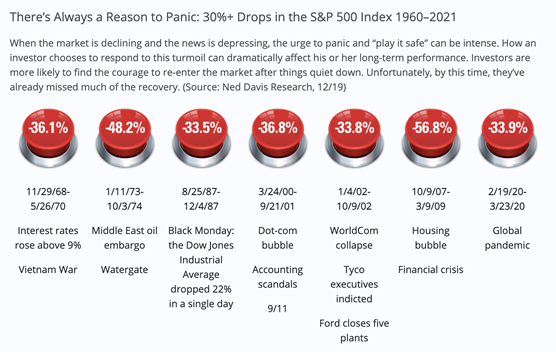
1. Today’s Volatility Is Not New

In March 2022, Harford Funds published a chart that displays some of the market dips of 30 percent or more in the S&P 500 Index drops over the past 61 years.

2. Panic could cost you in at least three ways

Market drops are normal. From January 1, 1980, to December 2021, the S&P 500 Index saw average annual drops of 14 percent, yet the average return over that period was 9.4 percent per year. With that in mind, let’s look at three ways that panic could cost you.

A. Focusing on the negative, which leads to fear

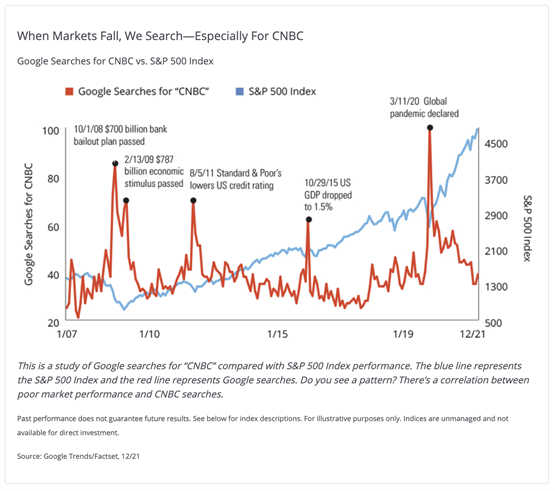
According to Newsweek, many cable news networks saw a dramatic increase in ratings during their 24/7 Coronavirus coverage. As shown in the chart below, from March 16–20, Fox News saw its ratings climb 89 percent over the same time last year, to 881,000 primetime viewers per day ages 25–54. CNN was up 193 percent to 790,000 and MSNBC climbed 56 percent to 570,000.

Making decisions based on fear creates a self-fulfilling market prophecy — more people are watching the news, which means more people are seeing examples of stories that can cause market instability, which gives them anxiety and could lead to fear-based investment decisions. This kind of mindset is contagious.

As Hartford Funds so accurately puts it, “When we’re anxious, we’re more likely to allocate our attention to negative information. Given the choice between information that may offer an optimistic perspective or data that paints a bleak future, an anxiety-influenced investor may naturally focus on threatening information.” When investors focus on that information, they tend to “play it safe” with their investments, potentially losing out.

B. Playing it safe

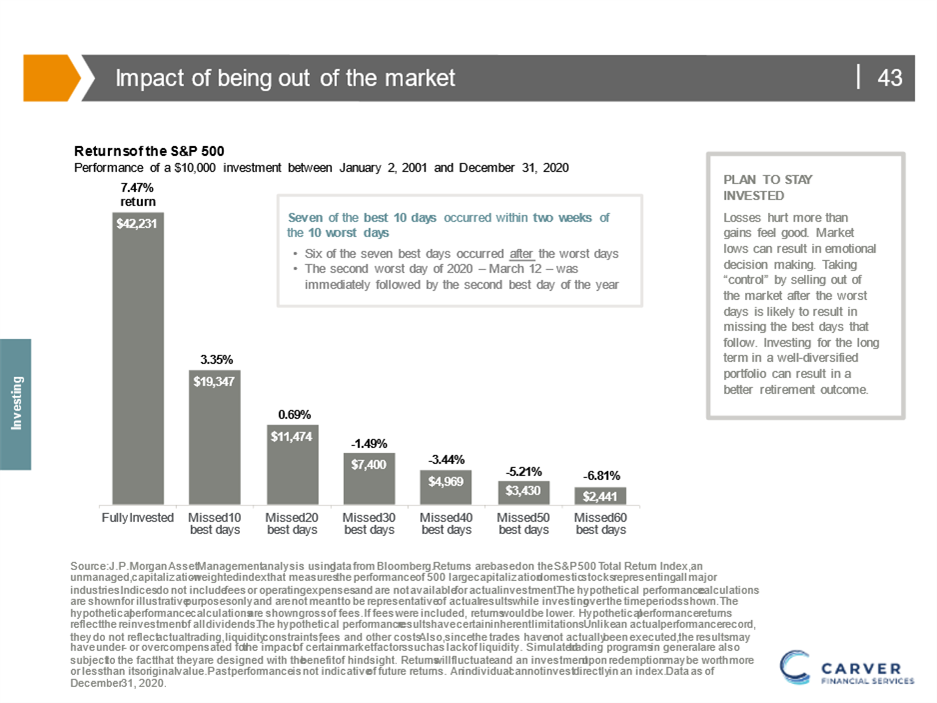
When a person senses instability, the natural instinct is to do everything possible to cultivate protection. This may mean moving to cash or fixed income. The problem with either action is that often, the best days in the market are within a week or two of the worst days, and you miss them. Missing just a few days can result in permanent loss.

In the two decades from 2001 to 2021, we experienced three bull markets and three bear markets, along with the terrorist attacks in 2001, the financial crisis in 2008 and the COVID-19 pandemic of 2020–22. Yet despite these unprecedented events, the S&P 500 still managed to generate a total annual return of 8.06 percent with reinvested dividends. The total return over this period was 409.13 percent. This means that a $10,000 investment made at the beginning of 2001 would have been $50,913.05 by the end of 2021.

Some investors move to bonds in an effort to avoid losses. However, moving to bonds not only may cause you to miss market returns but also to lose value in the bonds themselves. As interest rates rise, bond prices will drop. For the first time in several decades, we are seeing interest rates rise. The chart below shows how being out of the market could impact your portfolio.

C. Losing perspective — our economy is strong

When people feel panic setting in, they tend to change their behaviors to try to alleviate that feeling. As mentioned, this reaction or a focus on inflated safety can contribute to the loss of gains when the market does recover.

It is also common for individuals to see the market dropping and decide to abandon their overall plan to “stop the bleeding” and then wait for things to get better. This is market timing, and it doesn’t work.” As we have said previously, by trying to time the market, you potentially miss out on rallies. There is endless research out there proving that investors who try to time the market by hopping in and out of investments when the going gets tough often fail. It’s impossible to pick the accurate moment to dive in or pull out. We’re here to encourage you to maintain your perspective and to have a plan in place for when you need short-term cash and long-term cash.

Today the markets and economy are relatively strong. We are facing the headwinds of higher interest rates and inflation; however, overall earnings for companies remain strong. Moreover, as we have more uncertainly in Europe, the Middle East and even Canada, more funds will be directed to the United States. It has been said that our government is dysfunctional but stable.

According to the Bureau of Labor Statistics, the U.S. GDP grew 5.7 percent in 2021 after decreasing 3.4 percent in 2020, and GDP reached almost $23 trillion in 2021. This is the highest GDP growth rate in 37 years.

Thanks to stimulus checks, unemployment insurance and the Child Tax Credit, Americans have an average of 50 percent more money in their bank accounts than before the pandemic. Overall, wages are up, increasing by as much as 11 percent in some sectors. Unemployment has fallen to an astonishing 4.6 percent, back down to pre-pandemic levels. In the midst of a global pandemic, 11 million people were lifted out of poverty in 2020.

Corporate earnings numbers for Q1 2022 have been great. Right now, figures reflect S&P 500 earnings per share, tracking to a 31 percent year-over-year increase. (Yahoo! News) Now, of course this is all easier said than done. However, there are some helpful charts and years of data to show why what we are seeing is not new and also why panic may lead to very poor decisions.

3. There is opportunity in the market downturns

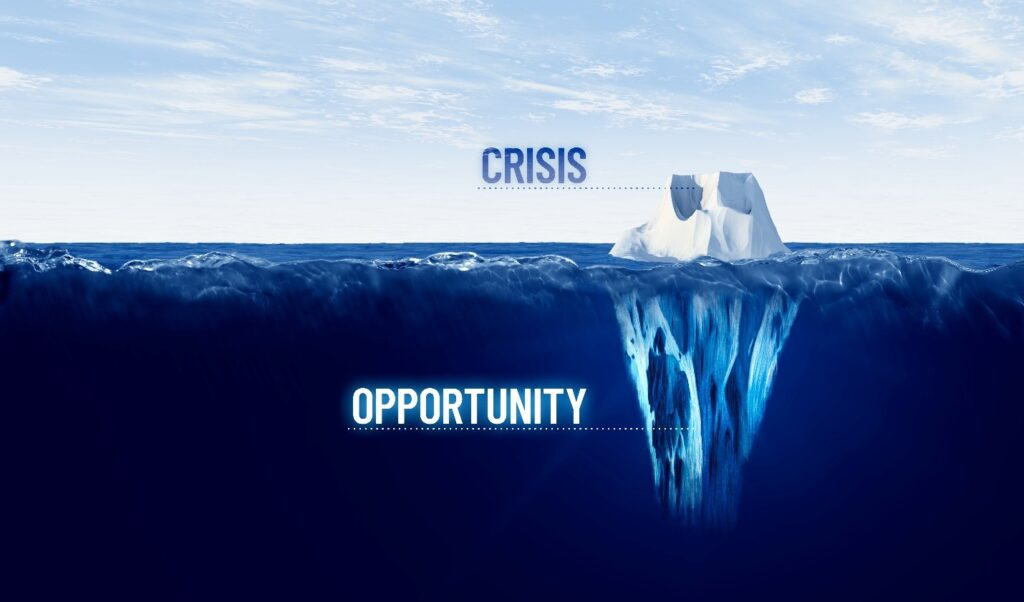
What many people don’t realize is that uncertainty can actually create opportunity for those who take advantage of the situation.

In one of our 2021 blog posts, “Volatility Is Our Friend,” we discussed strategies investors can use to benefit from volatility, including tax swaps and rebalancing from equity to fixed income or vice versa. Our team can help you discover and leverage the opportunities that are inherent in market downturns.

As Winston Churchill said, “Never let a good crisis go to waste.”

________

Ultimately, it’s impossible to manage your emotions in a vacuum. The media are almost solely focused on the negative. There have always been pandemics, geopolitical events and concerns about the economy, going back 1,000 years. The one thing that has changed is the volume of information we are exposed to.

Our team is here to help you make decisions based on facts and needs — not emotions or panic. With more than 250 years of combined experience, our team is here for you. It’s likely the news will get worse and markets will be volatile. Our Personal Vision Planning® process takes into account the unforeseen. Feel free to reach out to us any time. Your vision is our priority.

________

Randy Carver, CRPC®, CDFA®, is the president and founder of Carver Financial Services, Inc., and is also a registered principal with Raymond James Financial Services, Inc. Randy has more than 32 years of experience in the financial services business. Carver Financial Services, Inc,. was established in 1990 and is one of the largest independent financial services offices in the country, managing $2.2 billion in assets for clients globally, as of December 2021. Randy and his team work with individuals who are in financial transition as a result of divorce, retirement or the sale of a business. You may reach Randy at randy.carver@raymondjames.com.

The information contained in this post does not purport to be a complete description of the securities, markets or developments referred to in this material. The information has been obtained from sources considered to be reliable, but we do not guarantee that the foregoing material is accurate or complete. Any information is not a complete summary or statement of all available data necessary for making an investment decision and does not constitute a recommendation. Any opinions are those of Randy Carver and not necessarily those of RJFS or Raymond James. Expressions of opinion are as of this date and are subject to change without notice.

Returns are based on the S&P 500 Total Return Index, an unmanaged, capitalization-weighted index that measures the performance of 500 large capitalization domestic stocks representing all major industries. Indices do not include fees or operating expenses and are not available for actual investment. The hypothetical performance calculations are shown for illustrative purposes only and are not meant to be representative of actual results while investing over the time periods shown. The hypothetical performance calculations are shown gross of fees. If fees were included, returns would be lower. Hypothetical performance returns reflect the reinvestment of all dividends. The hypothetical performance results have certain inherent limitations. Unlike an actual performance record, they do not reflect actual trading, liquidity constraints, fees and other costs.

Also, because the trades have not actually been executed, the results may have under- or overcompensated for the impact of certain market factors such as lack of liquidity. Simulated trading programs in general are also subject to the fact that they are designed with the benefit of hindsight. Returns will fluctuate and an investment upon redemption may be worth more or less than its original value. Past performance is not indicative of future returns. An individual cannot invest directly in an index.

Category: Blog

Preserving & Passing: An Asset Protection & Estate Planning Event

March 23, 2022 //  by Paige Courtot


  • Seminar Material

Carver Financial Services – 2022 Estate Planning Event

The Carver Financial team explores best practices for preserving, protecting and passing on your tangible and intangible assets. As we face rapidly changing estate tax rules, increased risks long-term care events and new forms of digital assets, it’s more important than ever to understand the challenges and opportunities before you. We will share the latest best practices and guide you on next steps.

Category: Video

Barron’s names Randy Carver to its Top 1200 Financial Advisors List for 2022

March 15, 2022 //  by Paige Courtot

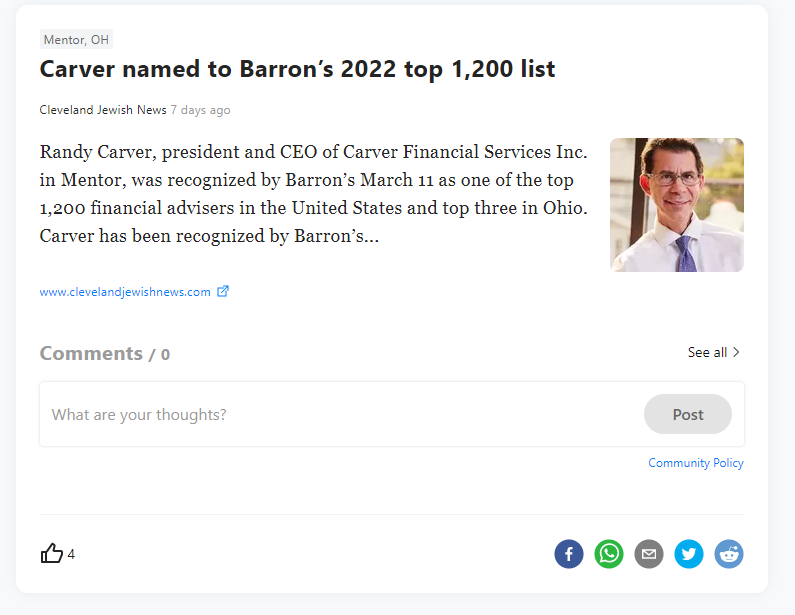
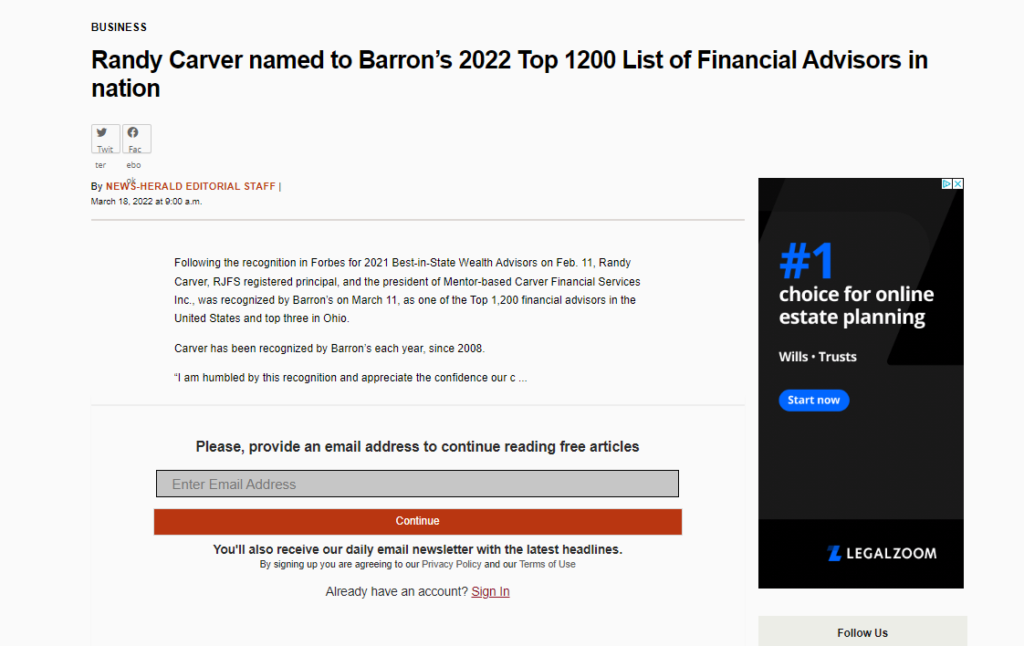
March 15, 2022 – Barron’s Magazine, again, named Randy Carver, RJFS Registered Principal and President of Carver Financial Services, as one of the top advisors in the Nation and ranked third for the state of Ohio. Randy has been recognized by Barron’s every year since 2008.

Rankings are based on data provided by the nation’s 6,000 most productive advisors. Factors included in the rankings: assets under management, revenue produced for the firm, regulatory record, quality of practice and philanthropic work. Investment performance isn’t an explicit component because not all advisors have audited results and because performance figures often are influenced more by clients’ risk tolerance than by an advisor’s investment-picking abilities. Barron’s listed their top 1,200 putting Randy in the top 4/10th of 1% of all advisors.

To see the full listing click here.

Source: Barron’s “Top 1,200 Financial Advisors,” March 2022. Barron’s is a registered trademark of Dow Jones & Company, L.P. All rights reserved. The rankings are based on data provided by 6,186 individual advisors and their firms and include qualitative and quantitative criteria. Factors included in the rankings: assets under management, revenue produced for the firm, regulatory record, quality of practice and philanthropic work. Investment performance is not an explicit component because not all advisors have audited results and because performance figures often are influenced more by clients’ risk tolerance than by an advisor’s investment picking abilities. The ranking may not be representative of any one client’s experience, is not an endorsement, and is not indicative of advisor’s future performance. Neither Raymond James nor any of its Financial Advisors pay a fee in exchange for this award/rating. Barron’s is not affiliated with Raymond James.

Category: Awards

  • « Go to Previous Page
  • Page 1
  • Interim pages omitted …
  • Page 16
  • Page 17
  • Page 18
  • Page 19
  • Page 20
  • Interim pages omitted …
  • Page 34
  • Go to Next Page »

Footer

Let’s Get Started


We’re ready to help you achieve your vision. Contact our team today.

Contact us

OUR APPROACH
ABOUT US
RESOURCES
EXPERIENCES

CONTACT US

OUR OFFICES
7473 Center St.
Mentor, OH 44060
Phone: 440.974.0808
Toll-Free: 800.627.7279
Email: carverfinancialservices@ raymondjames.com

STAY IN TOUCH
         twitter   

RECOGNIZED BY


(Please click here for award criteria & disclosures.)

Securities offered through Raymond James Financial Services, Inc., member FINRA / SIPC. Investment advisory services offered through Raymond James Financial Services Advisors Inc. Carver Financial Services is not a registered broker/dealer and is independent of Raymond James Financial Services.

Raymond James financial advisors may only conduct business with residents of the states and/or jurisdictions for which they are properly registered. Therefore, a response to a request for information may be delayed. Please note that not all of the investments and services mentioned are available in every state. Investors outside of the United States are subject to securities and tax regulations within their applicable jurisdictions that are not addressed on this site. Contact your local Raymond James office for information and availability.

Links are being provided for information purposes only. Raymond James is not affiliated with and does not endorse, authorize or sponsor any of the listed websites or their respective sponsors. Raymond James is not responsible for the content of any website or the collection or use of information regarding any website’s users and/or members.

Site Footer

Copyright© 2026 · Carver Financial Services · Our Privacy Policy · Member FINRA/SIPC · Legal Disclosures